- 您现在的位置:买卖IC网 > PDF目录16944 > ADP161UJ-EVALZ (Analog Devices Inc)BOARD EVALUATION ADJUSTABLE PDF资料下载
参数资料
| 型号: | ADP161UJ-EVALZ |
| 厂商: | Analog Devices Inc |
| 文件页数: | 16/24页 |
| 文件大小: | 0K |
| 描述: | BOARD EVALUATION ADJUSTABLE |
| 标准包装: | 1 |
| 每 IC 通道数: | 1 - 单 |
| 输出电压: | 1 ~ 4 V |
| 电流 - 输出: | 150mA |
| 输入电压: | 2.2 V ~ 5.5 V |
| 稳压器类型: | 正,可调式 |
| 工作温度: | -40°C ~ 125°C |
| 板类型: | 完全填充 |
| 已供物品: | 板 |
| 已用 IC / 零件: | ADP161 |
ADP160/ADP161/ADP162/ADP163
Consider the case where a hard short from OUT to ground
occurs. At first, the ADP16x current limit so that only 320 mA
Table 9. Typical Ψ JB Values
Ψ JB (°C/W)
Data Sheet
is conducted into the short. If self-heating of the junction is
great enough to cause its temperature to rise above 150°C,
thermal shutdown activates, turning off the output and
reducing the output current to zero. As the junction tempera-
ture cools and drops below 135°C, the output turns on and
conducts 320 mA into the short, again causing the junction
TSOT WLCSP
42.8 58.4
The junction temperature of the ADP16x can be calculated
from the following equation:
T J = T A + ( P D × θ JA )
(2)
temperature to rise above 150°C. This thermal oscillation
between 135°C and 150°C causes a current oscillation between
320 mA and 0 mA that continues as long as the short remains
at the output.
Current and thermal limit protections are intended to protect
the device against accidental overload conditions. For reliable
operation, device power dissipation must be externally limited
so junction temperatures do not exceed 125°C.
THERMAL CONSIDERATIONS
In most applications, the ADP16x do not dissipate much heat due
to their high efficiency. However, in applications with high ambient
temperature and high supply voltage to output voltage differential,
the heat dissipated in the package is large enough that it can cause
the junction temperature of the die to exceed the maximum
junction temperature of 125°C.
When the junction temperature exceeds 150°C, the converter enters
thermal shutdown. It recovers only after the junction temperature
has decreased below 135°C to prevent any permanent damage.
Therefore, thermal analysis for the chosen application is very
important to guarantee reliable performance over all conditions.
The junction temperature of the die is the sum of the ambient
temperature of the environment and the temperature rise of the
package due to the power dissipation, as shown in Equation 2.
To guarantee reliable operation, the junction temperature of
the ADP16x must not exceed 125°C. To ensure the junction
temperature stays below this maximum value, the user needs to
be aware of the parameters that contribute to junction temperature
changes. These parameters include ambient temperature, power
dissipation in the power device, and thermal resistances between
the junction and ambient air (θ JA ). The θ JA number is dependent
on the package assembly compounds that are used and the amount
of copper used to solder the package GND pins to the PCB.
4-ball WLCSP for various PCB copper sizes. Table 9 shows the
typical Ψ JB value of the 5-lead TSOT and 4-ball WLCSP.
Table 8. Typical θ JA Values
θ JA (°C/W)
where:
T A is the ambient temperature.
P D is the power dissipation in the die, given by
P D = [( V IN ? V OUT ) × I LOAD ] + ( V IN × I GND ) (3)
where:
I LOAD is the load current.
I GND is the ground current.
V IN and V OUT are input and output voltages, respectively.
Power dissipation due to ground current is quite small and can be
ignored. Therefore, the junction temperature equation simplifies to
the following:
T J = T A + {[( V IN ? V OUT ) × I LOAD ] × θ JA } (4)
As shown in Equation 4, for a given ambient temperature, input-
to-output voltage differential, and continuous load current, there
exists a minimum copper size requirement for the PCB to ensure
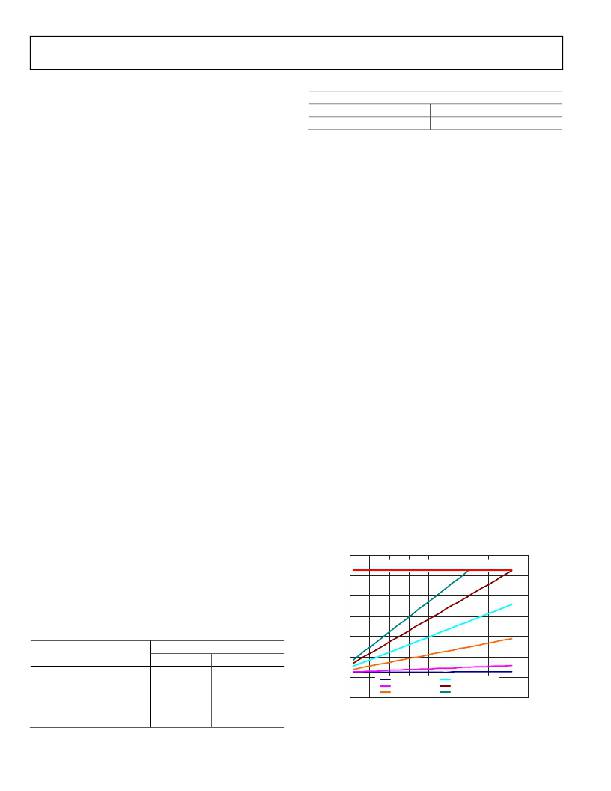
the junction temperature does not rise above 125°C. Figure 41 to
different ambient temperatures, load currents, V IN -to-V OUT
differentials, and areas of PCB copper.
In the case where the board temperature is known, use the
thermal characterization parameter, Ψ JB , to estimate the junction
temperature rise (see Figure 49 and Figure 50). Maximum
junction temperature (T J ) is calculated from the board
temperature (T B ) and power dissipation (P D ) using the
following formula:
T J = T B + ( P D × Ψ JB ) (5)
The typical value of Ψ JB is 58°C/W for the 4-ball WLCSP package
and 43°C/W for the 5-lead TSOT package.
140
MAXIMUM JUNCTION TEMPERATURE
120
100
80
60
Copper Size (mm 2 )
TSOT
WLCSP
40
I LOAD = 1mA
I LOAD = 100mA
0 1
50
100
300
500
170
152
146
134
131
260
159
157
153
151
20
I LOAD = 10mA I LOAD = 150mA
I LOAD = 50mA I LOAD = 200mA
0
0.3 0.8 1.3 1.8 2.3 2.8 3.3 3.8 4.3
V IN – V OUT (V)
Figure 41. 500 mm 2 of PCB Copper, WLCSP, T A = 25°C
4.8
1
Device soldered to minimum size pin traces.
Rev. H | Page 16 of 24
相关PDF资料 |
PDF描述 |
|---|---|
| 380LX271M400J452 | CAP ALUM 270UF 400V 20% SNAP |
| VI-20D-EY | CONVERTER MOD DC/DC 85V 50W |
| ADP220-2828-EVALZ | BOARD EVALUATION 2.8V/2.8V |
| 0210490357 | CABLE JUMPER 1.25MM .203M 28POS |
| MIC2004-0.8YM5 | IC DISTRIBUTION SW 0.8A SOT23-5 |
相关代理商/技术参数 |
参数描述 |
|---|---|
| ADP-162 D | 功能描述:MDS-030AACXX UK VERSION DUCKHEAD 制造商:delta electronics 系列:MDS 零件状态:新产品 配件类型:适配器插头 配套使用产品/相关产品:墙式转接器(多插头) 标准包装:1 |
| ADP1621 | 制造商:AD 制造商全称:Analog Devices 功能描述:Constant-Frequency, Current-Mode Step-Up DC/DC Controller |
| ADP1621ARMZ | 制造商:Analog Devices 功能描述:DC DC Cntrlr Single-OUT Step Up 2.9V to 5.5V Input 10-Pin MSOP 制造商:Analog Devices 功能描述:DC-DC CONTROLLER PWM SMD MSOP10 制造商:Analog Devices 功能描述:DC-DC CONTROLLER, PWM, SMD, MSOP10 |
| ADP1621ARMZ-R7 | 功能描述:IC REG CTRLR PWM CM 10-MSOP RoHS:是 类别:集成电路 (IC) >> PMIC - 稳压器 - DC DC 切换控制器 系列:- 特色产品:LM3753/54 Scalable 2-Phase Synchronous Buck Controllers 标准包装:1 系列:PowerWise® PWM 型:电压模式 输出数:1 频率 - 最大:1MHz 占空比:81% 电源电压:4.5 V ~ 18 V 降压:是 升压:无 回扫:无 反相:无 倍增器:无 除法器:无 Cuk:无 隔离:无 工作温度:-5°C ~ 125°C 封装/外壳:32-WFQFN 裸露焊盘 包装:Digi-Reel® 产品目录页面:1303 (CN2011-ZH PDF) 其它名称:LM3754SQDKR |
| ADP1621-BL2-EVZ | 制造商:Analog Devices 功能描述:BLANK ADISIMPOWER EVAL ADP1621 - Boxed Product (Development Kits) |
发布紧急采购,3分钟左右您将得到回复。