- 您现在的位置:买卖IC网 > PDF目录296253 > ISO120SGQ Precision Low Cost ISOLATION AMPLIFIER PDF资料下载
参数资料
| 型号: | ISO120SGQ |
| 元件分类: | 隔离放大器 |
| 英文描述: | Precision Low Cost ISOLATION AMPLIFIER |
| 中文描述: | 精密低成本隔离放大器 |
| 文件页数: | 13/16页 |
| 文件大小: | 184K |
| 代理商: | ISO120SGQ |
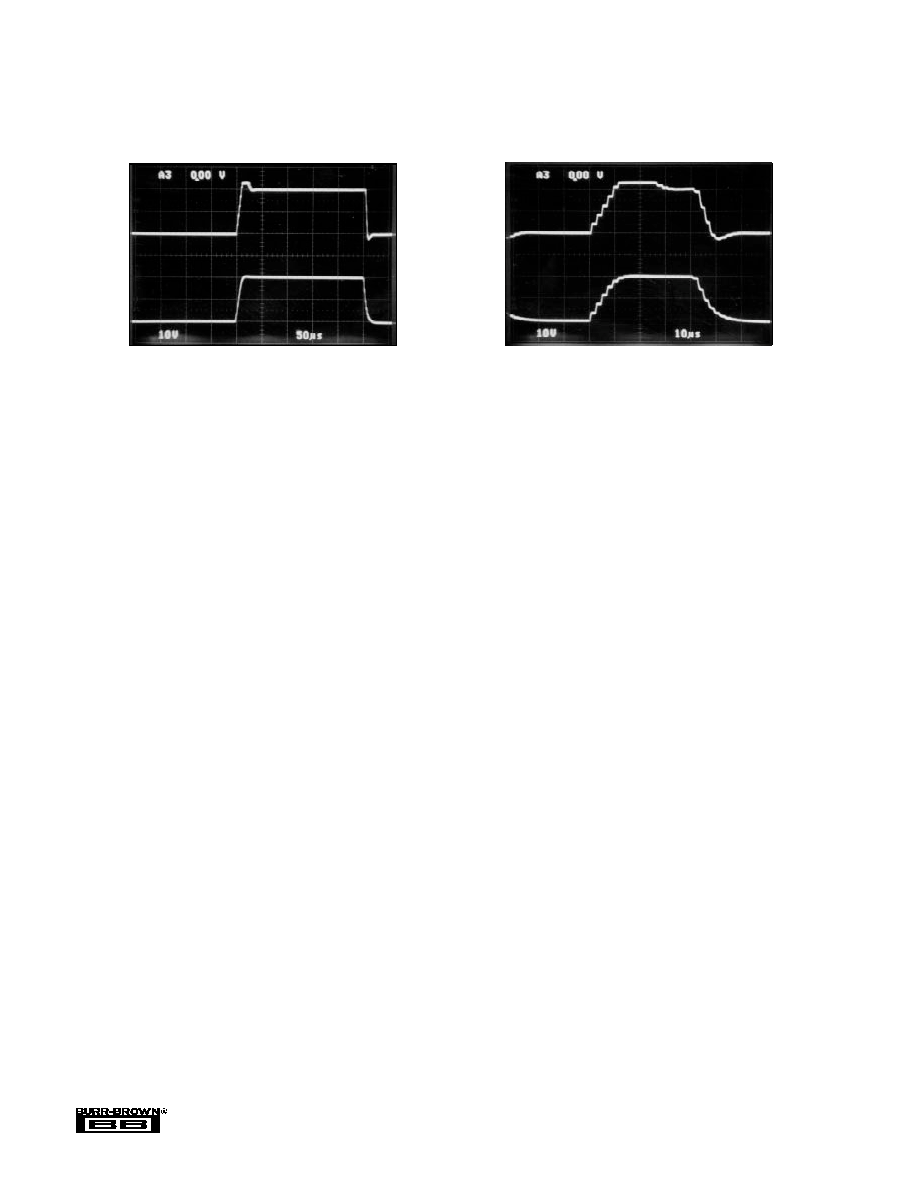
6
ISO120/121
Output
Voltage
(V)
STEP RESPONSE
Time (s)
50
0
100
+10
0
–10
+10
0
–10
Output
Voltage
(V)
STEP RESPONSE
Time (s)
250
0
500
+10
0
–10
+10
0
–10
TYPICAL PERFORMANCE CURVES (CONT)
T
A = +25°C; VS1 = VS2 = ±15V; and RL = 2k, unless otherwise noted.
THEORY OF OPERATION
The ISO120 and ISO121 isolation amplifiers comprise input
and output sections galvanically isolated by matched 1pF
capacitors built into the ceramic barrier. The input is duty-
cycle modulated and transmitted digitally across the barrier.
The output section receives the modulated signal, converts it
back to an analog voltage and removes the ripple component
inherent in the demodulation. The input and output sections
are laser-trimmed for exceptional matching of circuitry com-
mon to both input and output sections.
FREE-RUNNING MODE
An input amplifier (A1, Figure1) integrates the difference
between the input current (V
IN/200k)
and a switched
±100A current source. This current source is implemented
by a switchable 200
A source and a fixed 100A current
sink. To understand the basic operation of the input section,
assume that V
IN
= 0. The integrator will ramp in one
direction until the comparator threshold is exceeded. The
comparator and sense amp will force the current source to
switch; the resultant signal is a triangular waveform with a
50% duty cycle. If V
IN
changes, the duty cycle of the
integrator will change to keep the average DC value at the
output of A1 near zero volts. This action converts the input
voltage to a duty-cycle modulated triangular waveform at
the output of A1 near zero volts. This action converts the
input voltage to a duty-cycle modulated triangular wave-
form at the output of A1 with a frequency determined by the
internal 150pF capacitor. The comparator generates a fast
rise time square wave that is simultaneously fed back to keep
A1 in charge balance and also across the barrier to a
differential sense amplifier with high common-mode rejec-
tion characteristics. The sense amplifier drives a switched
current source surrounding A2. The output stage balances
the duty-cycle modulated current against the feedback cur-
rent through the 200k
feedback resistor, resulting in an
average value at the Sense pin equal to V
IN. The sample and
hold amplifiers in the output feedback loop serve to remove
undesired ripple voltages inherent in the demodulation process.
SYNCHRONIZED MODE
A unique feature of the ISO120 and ISO121 is the ability to
synchronize the modulator to an external signal source. This
capability is useful in eliminating trouble-some beat fre-
quencies in multi-channel systems and in rejecting AC
signals and their harmonics. To use this feature, external
capacitors are connected at C
1 and C2 (Figure 1) to change
the free-running carrier frequency. An external signal is
applied to the Ext Osc pin. This signal forces the current
source to switch at the frequency of the external signal. If
V
IN is zero, and the external source has a 50% duty cycle,
operation proceeds as described above, except that the switch-
ing frequency is that of the external source. If the external
signal has a duty cycle other than 50%, its average value is
not zero. At start-up, the current source does not switch until
the integrator establishes an output equal to the average DC
value of the external signal. At this point, the external signal
is able to trigger the current source, producing a triangular
waveform, symmetrical about the new DC value, at the
output of A1. For V
IN = 0, this waveform has a 50% duty
cycle. As V
IN varies, the waveform retains its DC offset, but
varies in duty cycle to maintain charge balance around A1.
Operation of the demodulator is the same as outlined above.
Synchronizing to a Sine
or Triangle Wave External Clock
The ideal external clock signal for the ISO120/121 is a
±4V
sine wave or
±4V, 50% duty-cycle triangle wave. The ext osc
pin of the ISO120/121 can be driven directly with a
±3V to
±5V sine or 25% to 75% duty-cycle triangle wave and the ISO
amp's internal modulator/demodulator circuitry will synchro-
nize to the signal.
Synchronizing to signals below 400kHz requires the addition
of two external capacitors to the ISO120/121. Connect one
capacitor in parallel with the internal modulator capacitor and
connect the other capacitor in parallel with the internal de-
modulator capacitor as shown in Figure 1.
相关PDF资料 |
PDF描述 |
|---|---|
| ISTPCH4MBLY | INTERCONNECTION DEVICE |
| ISTPCHNC2MBLY | INTERCONNECTION DEVICE |
| J14WMT-R | FEMALE, BNC CONNECTOR, JACK |
| J14WM | FEMALE, BNC CONNECTOR, JACK |
| J14HT-R | FEMALE, TNC CONNECTOR, JACK |
相关代理商/技术参数 |
参数描述 |
|---|---|
| ISO121 | 制造商:BB 制造商全称:BB 功能描述:Precision Low Cost ISOLATION AMPLIFIER |
| ISO1211D | 功能描述:ISOLATED 24-V DIGITAL INPUT RECE 制造商:texas instruments 系列:- 包装:管件 零件状态:在售 应用:PLC 数字输入模块 接口:数字 电压 - 电源:2.25 V ~ 5.5 V 封装/外壳:8-SOIC(0.154",3.90mm 宽) 供应商器件封装:8-SOIC 安装类型:表面贴装 标准包装:75 |
| ISO1211EVM | 功能描述:EVAL BOARD FOR ISO1211 制造商:texas instruments 系列:- 零件状态:在售 主要用途:接口,数字式隔离器 嵌入式:- 使用的 IC/零件:ISO1211 主要属性:板载测试点 辅助属性:- 所含物品:板 标准包装:1 |
| ISO1212DBQ | 功能描述:INDUSTRIAL IO 制造商:texas instruments 系列:- 包装:管件 零件状态:在售 应用:PLC 数字输入模块 接口:数字 电压 - 电源:2.25 V ~ 5.5 V 封装/外壳:16-SSOP(0.154",3.90mm 宽) 供应商器件封装:16-SSOP 安装类型:表面贴装 标准包装:75 |
| ISO1212DBQR | 功能描述:ISOLATED 24-V TO 60-V DIGITAL IN 制造商:texas instruments 系列:- 包装:剪切带(CT) 零件状态:在售 应用:PLC 数字输入模块 接口:数字 电压 - 电源:2.25 V ~ 5.5 V 封装/外壳:16-SSOP(0.154",3.90mm 宽) 供应商器件封装:16-SSOP 安装类型:表面贴装 标准包装:1 |
发布紧急采购,3分钟左右您将得到回复。