- 您现在的位置:买卖IC网 > PDF目录19467 > MAX6656MEE+ (Maxim Integrated)IC TEMP SENSOR 4CH 16-QSOP PDF资料下载
参数资料
| 型号: | MAX6656MEE+ |
| 厂商: | Maxim Integrated |
| 文件页数: | 10/18页 |
| 文件大小: | 0K |
| 描述: | IC TEMP SENSOR 4CH 16-QSOP |
| 产品培训模块: | Lead (SnPb) Finish for COTS Obsolescence Mitigation Program |
| 标准包装: | 100 |
| 功能: | 温度监控系统(传感器) |
| 传感器类型: | 内部和外部 |
| 感应温度: | -55°C ~ 125°C,外部传感器 |
| 精确度: | ±3°C(最小值) |
| 拓扑: | ADC,多路复用器,寄存器库 |
| 输出类型: | I²C?/SMBus? |
| 输出警报: | 是 |
| 输出风扇: | 是 |
| 电源电压: | 3 V ~ 5.5 V |
| 工作温度: | -55°C ~ 125°C |
| 安装类型: | 表面贴装 |
| 封装/外壳: | 16-SSOP(0.154",3.90mm 宽) |
| 供应商设备封装: | 16-QSOP |
| 包装: | 管件 |
Dual Remote/Local Temperature Sensors and
Four-Channel Voltage Monitors
places constraints on high-frequency noise rejection.
Lay out the PC board carefully with proper external
noise filtering for high-accuracy remote measurements
in electrically noisy environments. Filter high-frequency
electromagnetic interference (EMI) at DXP and DXN
with an external 2200pF capacitor connected between
GND
10MILS
the two inputs. This capacitor can be increased to
about 3300pF (max), including cable capacitance. A
capacitance higher than 3300pF introduces errors due
to the rise time of the switched-current source.
10MILS
10MILS
DXP
DXN
MINIMUM
If necessary, bypass V IN _ pins with any appropriate-
value capacitor for greater noise performance. Do not
put resistance in series with the inputs. Series resis-
tance degrades voltage measurements.
PC Board Layout
1) Place the MAX6655/MAX6656 as close as practical
to the remote diode. In a noisy environment, such as
a computer motherboard, this distance can be 4in to
8in (typ) or more, as long as the worst noise sources
(such as CRTs, clock generators, memory buses,
and ISA/PCI buses) are avoided.
2) Do not route the DXP-DXN lines next to the deflec-
tion coils of a CRT. Also, do not route the traces
across a fast memory bus, which can easily intro-
duce +30°C error, even with good filtering.
Otherwise, most noise sources are fairly benign.
3) Route the DXP and DXN traces parallel and close to
each other, away from any high-voltage traces such
as +12VDC. Avoid leakage currents from PC board
contamination. A 20m ? leakage path from DXP to
ground causes approximately +1°C error.
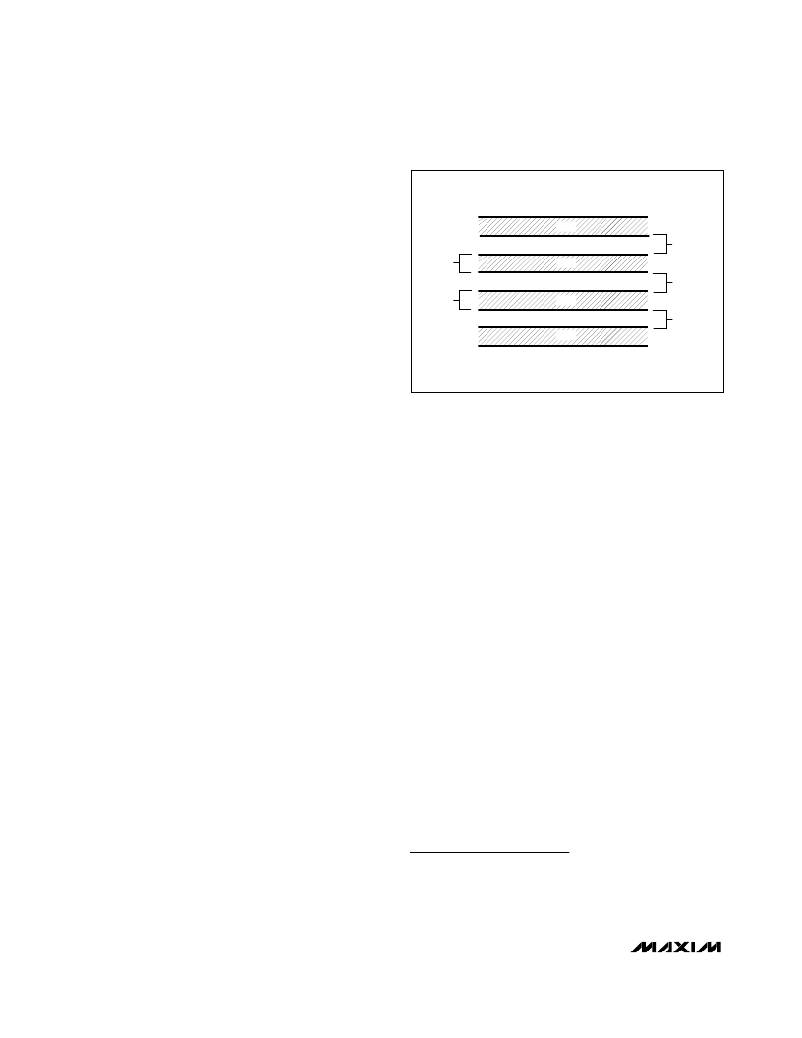
4) Connect guard traces to GND on either side of the
DXP-DXN traces when possible (Figure 5). With
guard traces in place, routing near high-voltage
traces is no longer an issue.
5) Route as few vias and crossunders as possible to
minimize copper/solder thermocouple effects.
6) When introducing a thermocouple, make sure that
both the DXP and the DXN paths have matching
thermocouples. In general, PC board-induced ther-
mocouples are not a serious problem. A copper-sol-
der thermocouple exhibits 3μV/°C, and it takes
approximately 200μV of voltage error at DXP-DXN to
cause a 1°C measurement error, so most parasitic
thermocouple errors are swamped out.
7) Use wide traces. Narrow traces are more inductive
and tend to pick up radiated noise. The 10-mil
widths and spacings recommended in Figure 5 are
not absolutely necessary (as they offer only a minor
10MILS
GND
Figure 5. Recommended DXP/DXN PC Traces
improvement in leakage and noise), but use them
where practical.
8) Note that copper cannot be used as an EMI shield.
Placing a copper ground plane between the DXP-
DXN traces and traces carrying high-frequency
noise signals does not help reduce EMI.
Twisted Pair and Shielded Cables
For remote-sensor distances longer than 8in, or in par-
ticularly noisy environments, a twisted pair is recom-
mended. Its practical length is 6ft to 12ft (typ) before
noise becomes a problem, as tested in a noisy elec-
tronics laboratory. For longer distances, the best solu-
tion is a shielded twisted pair like that used for audio
microphones. For example, Belden #8451 works well
for distances up to 100ft in a noisy environment.
Connect the twisted pair to DXP and DXN and the
shield to GND, and leave the shield’s remote end unter-
minated. Excess capacitance at DX_ limits practical
remote-sensor distances (see Typical Operating
Characteristics ).
For very long cable runs, the cable's parasitic capaci-
tance often provides noise filtering, so the recommend-
ed 2200pF capacitor can often be removed or reduced
in value.
Cable resistance also affects remote-sensor accuracy.
A 1 ? series resistance introduces about +1/2°C error.
Chip Information
TRANSISTOR COUNT: 26,783
PROCESS: BiCMOS
10
______________________________________________________________________________________
相关PDF资料 |
PDF描述 |
|---|---|
| MEV3S1205SC | CONV DC/DC 3W 12V IN 5V OUT SIP |
| ADSP-21363BBCZ-1AA | IC DSP 32BIT 333MHZ 136CSPBGA |
| GSM36DRAN | CONN EDGECARD 72POS R/A .156 SLD |
| TAP106M035CCS | CAP TANT 10UF 35V 20% RADIAL |
| ADSP-2186LBSTZ-160 | IC DSP CONTROLLER 16BIT 100LQFP |
相关代理商/技术参数 |
参数描述 |
|---|---|
| MAX6656MEE+ | 功能描述:板上安装温度传感器 Dual Remote/Local Temperature Sensor RoHS:否 制造商:Omron Electronics 输出类型:Digital 配置: 准确性:+/- 1.5 C, +/- 3 C 温度阈值: 数字输出 - 总线接口:2-Wire, I2C, SMBus 电源电压-最大:5.5 V 电源电压-最小:4.5 V 最大工作温度:+ 50 C 最小工作温度:0 C 关闭: 安装风格: 封装 / 箱体: 设备功能:Temperature and Humidity Sensor |
| MAX6656MEE+T | 功能描述:板上安装温度传感器 Dual Remote/Local Temperature Sensor RoHS:否 制造商:Omron Electronics 输出类型:Digital 配置: 准确性:+/- 1.5 C, +/- 3 C 温度阈值: 数字输出 - 总线接口:2-Wire, I2C, SMBus 电源电压-最大:5.5 V 电源电压-最小:4.5 V 最大工作温度:+ 50 C 最小工作温度:0 C 关闭: 安装风格: 封装 / 箱体: 设备功能:Temperature and Humidity Sensor |
| MAX6656MEE-G05 | 功能描述:板上安装温度传感器 RoHS:否 制造商:Omron Electronics 输出类型:Digital 配置: 准确性:+/- 1.5 C, +/- 3 C 温度阈值: 数字输出 - 总线接口:2-Wire, I2C, SMBus 电源电压-最大:5.5 V 电源电压-最小:4.5 V 最大工作温度:+ 50 C 最小工作温度:0 C 关闭: 安装风格: 封装 / 箱体: 设备功能:Temperature and Humidity Sensor |
| MAX6656MEE-T | 功能描述:板上安装温度传感器 Dual Remote/Local Temperature Sensor RoHS:否 制造商:Omron Electronics 输出类型:Digital 配置: 准确性:+/- 1.5 C, +/- 3 C 温度阈值: 数字输出 - 总线接口:2-Wire, I2C, SMBus 电源电压-最大:5.5 V 电源电压-最小:4.5 V 最大工作温度:+ 50 C 最小工作温度:0 C 关闭: 安装风格: 封装 / 箱体: 设备功能:Temperature and Humidity Sensor |
| MAX6656MEE-TG05 | 功能描述:板上安装温度传感器 RoHS:否 制造商:Omron Electronics 输出类型:Digital 配置: 准确性:+/- 1.5 C, +/- 3 C 温度阈值: 数字输出 - 总线接口:2-Wire, I2C, SMBus 电源电压-最大:5.5 V 电源电压-最小:4.5 V 最大工作温度:+ 50 C 最小工作温度:0 C 关闭: 安装风格: 封装 / 箱体: 设备功能:Temperature and Humidity Sensor |
发布紧急采购,3分钟左右您将得到回复。