- 您现在的位置:买卖IC网 > PDF目录98065 > PTH08000WAZT (TEXAS INSTRUMENTS INC) 1-OUTPUT DC-DC REG PWR SUPPLY MODULE PDF资料下载
参数资料
| 型号: | PTH08000WAZT |
| 厂商: | TEXAS INSTRUMENTS INC |
| 元件分类: | 电源模块 |
| 英文描述: | 1-OUTPUT DC-DC REG PWR SUPPLY MODULE |
| 封装: | ROHS COMPLIANT, DIP-6 |
| 文件页数: | 14/20页 |
| 文件大小: | 661K |
| 代理商: | PTH08000WAZT |
www.ti.com
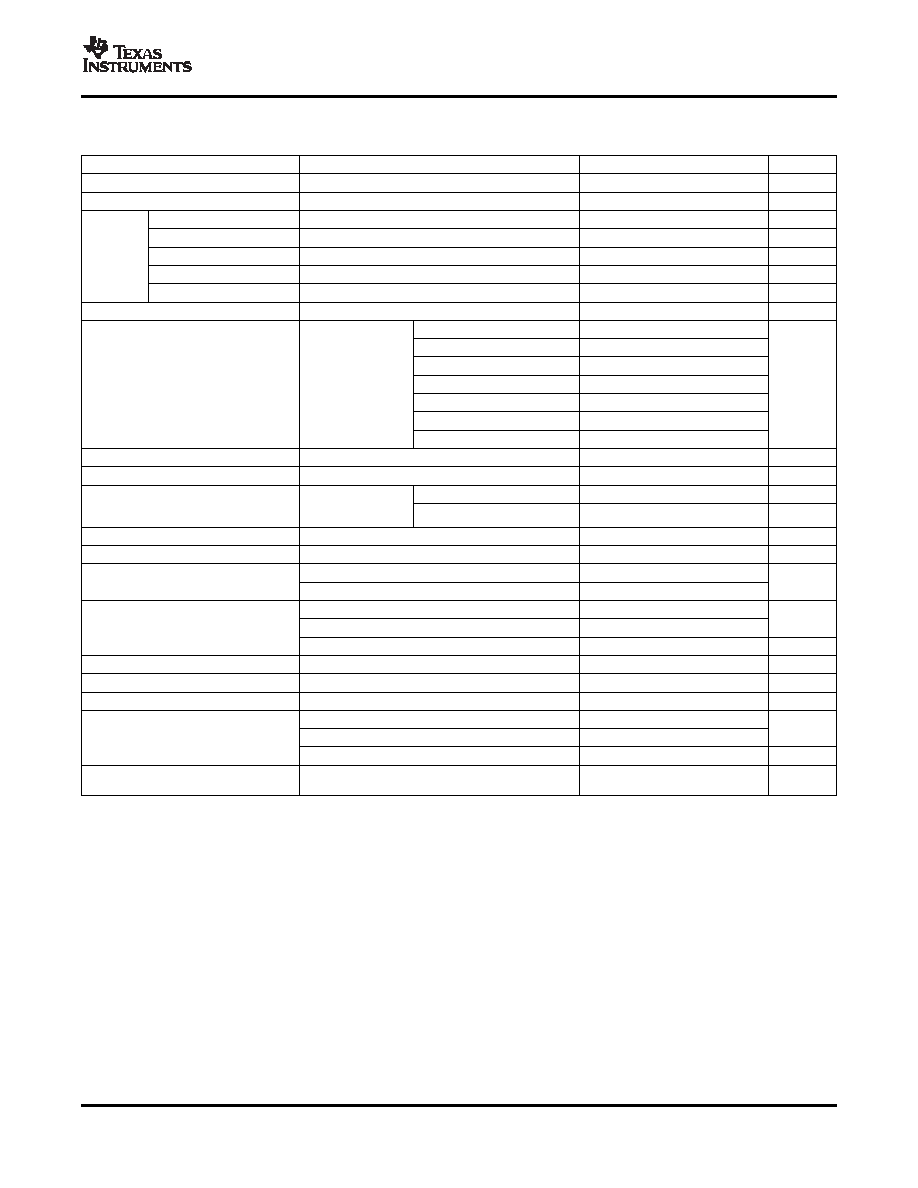
ELECTRICAL CHARACTERISTICS
SLTS248B – JUNE 2005 – REVISED FEBRUARY 2008
at 25
°C free-air temperature, V
I = 12 V, VO = 3.3 V, IO = IOmax, CI = 100 F (unless otherwise noted)
PARAMETER
TEST CONDITIONS
MIN
TYP
MAX
UNIT
IO
Output current
TA = 85°C, natural convection airflow
0
2.25
A
VI
Input voltage range
Over IO range
4.5 (1)
14
V
Set-point voltage tolerance
TA = 25°C
2 (2)
%
Temperature variation
-40
°C ≤ T
A ≤ 85°C
0.5
%VO
VO
Line regulation
Over VI range
7
mV
Load regulation
Over IO range
0.13
%VO
Total output voltage variation
Includes set-point, line, load, -40
°C ≤ T
A ≤ 85°C
3 (2)
%VO
V(ADJ)
Output Voltage Adjust Range
Over IO range
0.9
5.5
V
RSET = 346 , VO = 5 V
93.5%
RSET = 1.87 k, VO = 3.3 V
92%
RSET = 3.74 k, VO = 2.5 V
90.5%
TA = 25°C,
η
Efficiency
RSET = 6.19 k, VO = 2 V
89.5%
IO = 2 A
RSET = 8.06 k, VO = 1.8 V
88%
RSET = 13 k, VO = 1.5 V
86.5%
RSET = 27.4 k, VO = 1.2 V
84.5%
Output voltage ripple
20-MHz bandwidth
40
mVPP
Overcurrent threshold
Reset, followed by autorecovery
3.5
A
CO = 100 F, 1 A/s
Recovery time
50
s
Transient response
load step from 50% to
VO over/undershoot
100
mV
100% IOmax
IIL track
Track input current (pin 2)
Pin to GND
–130
A
dVtrack/dt
Track slew rate capability
CO ≤ CO(max)
1
V/ms
VI = increasing
4.35
4.5
UVLO
Undervoltage lockout
V
VI = decreasing
3.6
4
Input high voltage (VIH)
Open (3)
V
Inhibit control (pin 4)
Input low voltage (VIL)
–0.2
0.5
Input low current (IIL)
–5
A
II (stby)
Input standby current
Pins 5 and 2 connected
1
mA
fS
Switching frequency
Over VI and IO ranges
300
kHz
External input capacitance
Electrolytic type (CI)
100 (4)
F
Ceramic type (CO)
220
F
External output capacitance
Nonceramic type (CO)
100 (5)
330 (6)
Equivalent series resistance (nonceramic)
10 (7)
m
Per Telcordia SR-332, 50% stress,
MTBF
Calculated reliability
10.3
106 Hr
TA = 40°C, ground benign
(1)
The minimum input voltage is 4.5 V or (VO + 1.1) V, whichever is greater.
(2)
The set-point voltage tolerance is affected by the tolerance and stability of RSET. The stated limit is unconditionally met if RSET has a
tolerance of 1% with 100 ppm/
°C or better temperature stability.
(3)
This control pin has an internal pull-up to 3 V (TYP). Do not place an external pull-up on this pin. If it is left open-circuit, the module
operates when input power is applied. A small, low-leakage (< 100 nA) MOSFET is recommended for control. See the Application
section for further guidance.
(4)
An external 100-F electrolytic capacitor is required across the input (VI and GND) for proper operation. Locate the capacitor close to
the module.
(5)
An external output capacitor is not required for proper operation. Adding 100 F of distributed capacitance at the load improves the
transient response.
(6)
This is the calculated maximum capacitance. The minimum ESR limitation often results in a lower value. See the capacitor application
information for further guidance.
(7)
This is the minimum ESR for all the electrolytic (nonceramic) capacitance. Use 14 m
as the minimum when calculating the total
equivalent series resistance (ESR) using the maximum ESR values specified by the capacitor manufacturer.
Copyright 2005–2008, Texas Instruments Incorporated
3
Product Folder Link(s) :PTH08000W
相关PDF资料 |
PDF描述 |
|---|---|
| PTH08T240FAS | 1-OUTPUT DC-DC REG PWR SUPPLY MODULE |
| PTH08T240FAST | 1-OUTPUT DC-DC REG PWR SUPPLY MODULE |
| PTH08T240FAD | 1-OUTPUT DC-DC REG PWR SUPPLY MODULE |
| PTH12010LAZT | 1-OUTPUT DC-DC REG PWR SUPPLY MODULE |
| PTH12010LAST | 1-OUTPUT DC-DC REG PWR SUPPLY MODULE |
相关代理商/技术参数 |
参数描述 |
|---|---|
| PTH08080W | 制造商:TI 制造商全称:Texas Instruments 功能描述:2.25-A, WIDE-INPUT ADJUSTABLE SWITCHING REGULATOR |
| PTH08080WAD | 功能描述:DC/DC转换器 2.25A Wide Input/ Out Adj Mini Pwr Mdl RoHS:否 制造商:Murata 产品: 输出功率: 输入电压范围:3.6 V to 5.5 V 输入电压(标称): 输出端数量:1 输出电压(通道 1):3.3 V 输出电流(通道 1):600 mA 输出电压(通道 2): 输出电流(通道 2): 安装风格:SMD/SMT 封装 / 箱体尺寸: |
| PTH08080WAH | 功能描述:DC/DC转换器 2.25A Wide Input/ Out Adj Mini Pwr Mdl RoHS:否 制造商:Murata 产品: 输出功率: 输入电压范围:3.6 V to 5.5 V 输入电压(标称): 输出端数量:1 输出电压(通道 1):3.3 V 输出电流(通道 1):600 mA 输出电压(通道 2): 输出电流(通道 2): 安装风格:SMD/SMT 封装 / 箱体尺寸: |
| PTH08080WAS | 功能描述:DC/DC转换器 2.25A Wide Input/ Out Adj Mini Pwr Mdl RoHS:否 制造商:Murata 产品: 输出功率: 输入电压范围:3.6 V to 5.5 V 输入电压(标称): 输出端数量:1 输出电压(通道 1):3.3 V 输出电流(通道 1):600 mA 输出电压(通道 2): 输出电流(通道 2): 安装风格:SMD/SMT 封装 / 箱体尺寸: |
| PTH08080WAST | 功能描述:DC/DC转换器 2.25A Wide Input/ Out Adj Mini Pwr Mdl RoHS:否 制造商:Murata 产品: 输出功率: 输入电压范围:3.6 V to 5.5 V 输入电压(标称): 输出端数量:1 输出电压(通道 1):3.3 V 输出电流(通道 1):600 mA 输出电压(通道 2): 输出电流(通道 2): 安装风格:SMD/SMT 封装 / 箱体尺寸: |
发布紧急采购,3分钟左右您将得到回复。