- 您现在的位置:买卖IC网 > Datasheet目录395 > AT86RF231-ZFR (Atmel)TXRX LOW POWER 2.4GHZ 32VQFN Datasheet资料下载
参数资料
| 型号: | AT86RF231-ZFR |
| 厂商: | Atmel |
| 文件页数: | 131/198页 |
| 文件大小: | 0K |
| 描述: | TXRX LOW POWER 2.4GHZ 32VQFN |
| 标准包装: | 1 |
| 频率: | 2.4GHz |
| 数据传输率 - 最大: | 2Mbps |
| 调制或协议: | 802.15.4 Zigbee,6LoWPAN,RF4CE,SP100,WirelessHART&trade,ISM |
| 应用: | 工业监控和控制,无线报警和安全系统 |
| 功率 - 输出: | -17dBm ~ 3dBm |
| 灵敏度: | -101dBm |
| 电源电压: | 1.8 V ~ 3.6 V |
| 电流 - 接收: | 12.3mA |
| 电流 - 传输: | 14mA |
| 数据接口: | PCB,表面贴装 |
| 天线连接器: | PCB,表面贴装 |
| 工作温度: | -40°C ~ 85°C |
| 封装/外壳: | 32-VFQFN 裸露焊盘 |
| 包装: | 剪切带 (CT) |
| 其它名称: | AT86RF231-ZFRCT |
第1页第2页第3页第4页第5页第6页第7页第8页第9页第10页第11页第12页第13页第14页第15页第16页第17页第18页第19页第20页第21页第22页第23页第24页第25页第26页第27页第28页第29页第30页第31页第32页第33页第34页第35页第36页第37页第38页第39页第40页第41页第42页第43页第44页第45页第46页第47页第48页第49页第50页第51页第52页第53页第54页第55页第56页第57页第58页第59页第60页第61页第62页第63页第64页第65页第66页第67页第68页第69页第70页第71页第72页第73页第74页第75页第76页第77页第78页第79页第80页第81页第82页第83页第84页第85页第86页第87页第88页第89页第90页第91页第92页第93页第94页第95页第96页第97页第98页第99页第100页第101页第102页第103页第104页第105页第106页第107页第108页第109页第110页第111页第112页第113页第114页第115页第116页第117页第118页第119页第120页第121页第122页第123页第124页第125页第126页第127页第128页第129页第130页当前第131页第132页第133页第134页第135页第136页第137页第138页第139页第140页第141页第142页第143页第144页第145页第146页第147页第148页第149页第150页第151页第152页第153页第154页第155页第156页第157页第158页第159页第160页第161页第162页第163页第164页第165页第166页第167页第168页第169页第170页第171页第172页第173页第174页第175页第176页第177页第178页第179页第180页第181页第182页第183页第184页第185页第186页第187页第188页第189页第190页第191页第192页第193页第194页第195页第196页第197页第198页
AT86RF231
When decrypting, due to the nature of AES algorithm, the initial key to be used is not the same
as the one used for encryption, but rather the last round key instead. This last round key is the
content of the key address space stored after running one full encryption cycle, and must be
saved for decryption. If the decryption key has not been saved, it has to be recomputed by first
running a dummy encryption (of an arbitrary plaintext) using the original encryption key, then
fetching the resulting round key from the key memory, and writing it back into the key memory as
the decryption key.
ECB decryption is not used by either IEEE 802.15.4 or ZigBee frame security. Both of these
standards do not directly encrypt the payload, but rather a nonce instead, and protect the pay-
load by applying an XOR operation between the resulting (AES-) cipher text and the original
payload. As the nonce is the same for encryption and decryption only ECB encryption is
required. Decryption is performed by XORing the received cipher text with its own encryption
result respectively, which results in the original plaintext payload upon success.
11.1.4.2
Cipher Block Chaining (CBC)
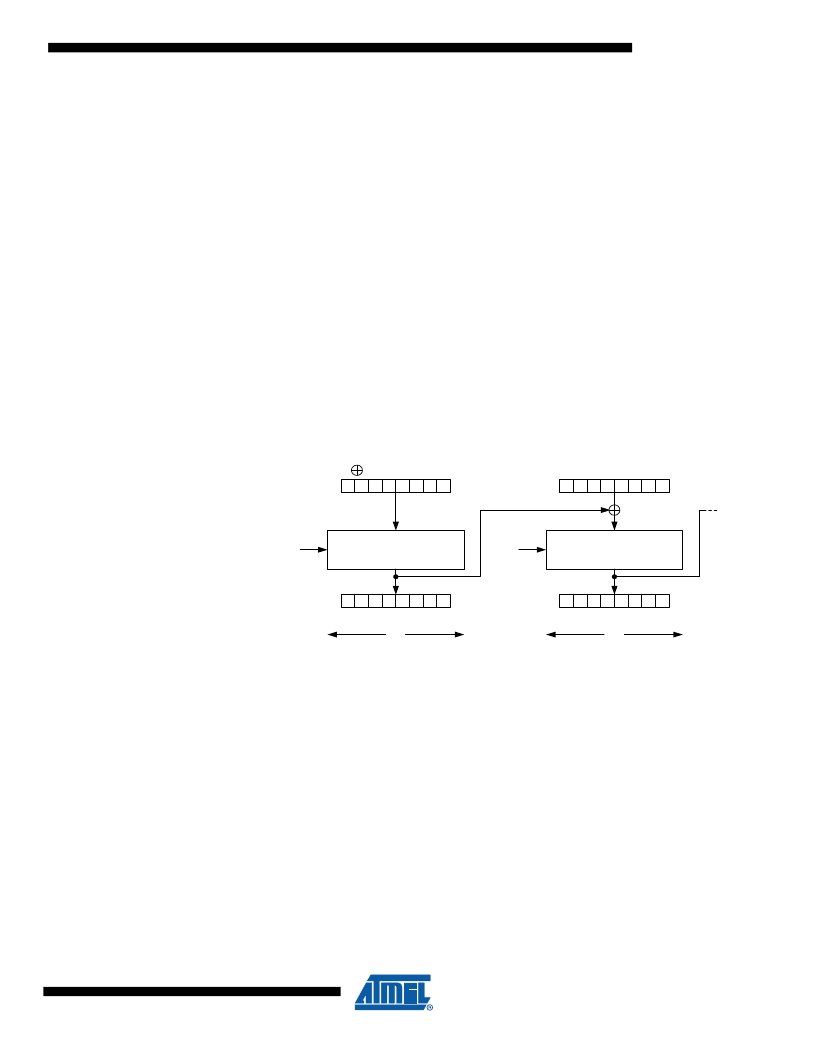
In CBC mode, the result of a previous AES operation is XORed with the new incoming vector,
forming the new plaintext to encrypt, see Figure 11-4 on page 131 . This mode is used for the
computation of a cryptographic checksum (message integrity code, MIC).
Figure 11-4. CBC Mode - Encryption
Plaintext
Initialization Vector (IV)
Plaintext
Encryption
Key
Block Cipher
Encryption
Ciphertext
ECB
mode
Encryption
Key
Block Cipher
Encryption
Ciphertext
CBC
mode
After preparing the AES key, and defining the AES operation direction using SRAM register bit
AES_DIR, the data has to be provided to the AES engine and the CBC operation can be started.
The first CBC run has to be configured as ECB to process the initial data (plaintext XORed with
an initialization vector provided by the microcontroller). All succeeding AES runs are to be con-
figured as CBC by setting register bits AES_MODE = 0x2 (register 0x83, AES_CTRL). Register
bit AES_DIR (register 0x83, AES_CTRL) must be set to AES_DIR = 0 to enable AES encryption.
The data to be processed has to be transferred to the SRAM starting with address 0x84 to 0x93
( r e g i s t e r A E S _ S T AT E ) . S e t t i n g r e g i s t e r b i t A E S _ R E Q U E S T = 1 ( r e g i s t e r 0 x 9 4 ,
AES_CTRL_MIRROR) as described in Section 11.1.4 “Security Operation Modes” on page 129
starts the first encryption within one SRAM access. This causes the next 128 bits of plaintext
data to be XORed with the previous cipher text data, see Figure 11-4 on page 131 .
According to IEEE 802.15.4 the input for the very first CBC operation has to be prepared by a
XORing a plaintext with an initialization vector (IV). The value of the initialization vector is 0.
However, for non-compliant usage any other initialization vector can be used. This operation has
to be prepared by the microcontroller.
131
8111C–MCU Wireless–09/09
相关PDF资料 |
PDF描述 |
|---|---|
| AT86RF232-ZX | 2.4 GHZ ZIGBEE TRANSCEIVER |
| AT88CK201BK | BRD CRYPTORF READER AT88RF1354 |
| AT88SC-ADK2 | KIT ARIS+ DK CRYPTOMEM/COMPANION |
| AT88SC3216CRF-MY1 | IC EEPROM 32KBIT 13MHZ TAG |
| ATA-2001 | LVDT AMPLIFIER |
相关代理商/技术参数 |
参数描述 |
|---|---|
| AT86RF231-ZU | 功能描述:射频收发器 2.4GHz Zigbee Transceiver RoHS:否 制造商:Atmel 频率范围:2322 MHz to 2527 MHz 最大数据速率:2000 Kbps 调制格式:OQPSK 输出功率:4 dBm 类型: 工作电源电压:1.8 V to 3.6 V 最大工作温度:+ 85 C 接口类型:SPI 封装 / 箱体:QFN-32 封装:Tray |
| AT86RF231-ZU_09 | 制造商:ATMEL 制造商全称:ATMEL Corporation 功能描述:Low Power 2.4 GHz Transceiver for ZigBee |
| AT86RF231-ZUR | 功能描述:射频收发器 2.4GHz, Zigbee Transceiver RoHS:否 制造商:Atmel 频率范围:2322 MHz to 2527 MHz 最大数据速率:2000 Kbps 调制格式:OQPSK 输出功率:4 dBm 类型: 工作电源电压:1.8 V to 3.6 V 最大工作温度:+ 85 C 接口类型:SPI 封装 / 箱体:QFN-32 封装:Tray |
| AT86RF232-ZX | 功能描述:射频收发器 2.4 GHZ ZIGBEE TRANSCEIVER RoHS:否 制造商:Atmel 频率范围:2322 MHz to 2527 MHz 最大数据速率:2000 Kbps 调制格式:OQPSK 输出功率:4 dBm 类型: 工作电源电压:1.8 V to 3.6 V 最大工作温度:+ 85 C 接口类型:SPI 封装 / 箱体:QFN-32 封装:Tray |
| AT86RF232-ZXR | 功能描述:射频收发器 2.4 GHZ ZIGBEE TRANSCEIVER RoHS:否 制造商:Atmel 频率范围:2322 MHz to 2527 MHz 最大数据速率:2000 Kbps 调制格式:OQPSK 输出功率:4 dBm 类型: 工作电源电压:1.8 V to 3.6 V 最大工作温度:+ 85 C 接口类型:SPI 封装 / 箱体:QFN-32 封装:Tray |
发布紧急采购,3分钟左右您将得到回复。