- 您现在的位置:买卖IC网 > PDF目录1839 > MAX17030GTL+ (Maxim Integrated Products)IC CTRLR VID QUICK-PWM 40-TQFN PDF资料下载
参数资料
| 型号: | MAX17030GTL+ |
| 厂商: | Maxim Integrated Products |
| 文件页数: | 33/39页 |
| 文件大小: | 0K |
| 描述: | IC CTRLR VID QUICK-PWM 40-TQFN |
| 产品培训模块: | Lead (SnPb) Finish for COTS Obsolescence Mitigation Program |
| 标准包装: | 60 |
| 系列: | Quick-PWM™ |
| 应用: | 控制器,Intel IMVP-6.5? SV,XE |
| 输入电压: | 7 V ~ 26 V |
| 输出数: | 1 |
| 输出电压: | 0.013 V ~ 1.5 V |
| 工作温度: | 0°C ~ 85°C |
| 安装类型: | 表面贴装 |
| 封装/外壳: | 40-WFQFN 裸露焊盘 |
| 供应商设备封装: | 40-TQFN-EP(5x5) |
| 包装: | 管件 |
第1页第2页第3页第4页第5页第6页第7页第8页第9页第10页第11页第12页第13页第14页第15页第16页第17页第18页第19页第20页第21页第22页第23页第24页第25页第26页第27页第28页第29页第30页第31页第32页当前第33页第34页第35页第36页第37页第38页第39页
1/2/3-Phase Quick-PWM
IMVP-6.5 VID Controllers
?
Maximum load current: There are two values to
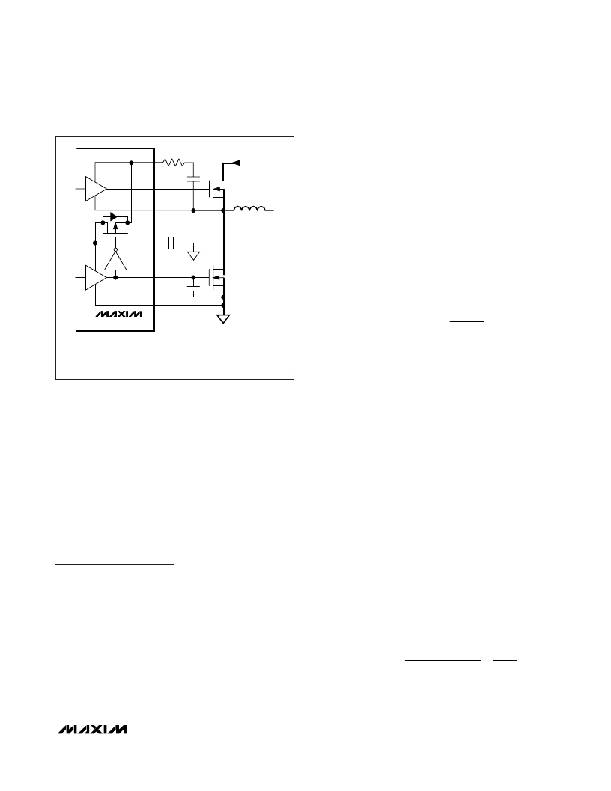
BST_
DH_
LX_
(R BST )*
C BST
N H
INPUT (V IN )
L
consider. The peak load current (I LOAD(MAX) ) deter-
mines the instantaneous component stresses and
filtering requirements, and thus drives output
capacitor selection, inductor saturation rating, and
the design of the current-limit circuit. The continu-
ous load current (I LOAD ) determines the thermal
stresses and thus drives the selection of input
I LOAD ( PHASE ) = LOAD
V DD
DL_
PGND
MAX17030/MAX17036
C BYP
(C NL )*
N L
capacitors, MOSFETs, and other critical heat-con-
tributing components. Modern notebook CPUs gen-
erally exhibit I LOAD = I LOAD(MAX) x 80%.
For multiphase systems, each phase supports a
fraction of the load, depending on the current bal-
ancing. When properly balanced, the load current is
evenly distributed among each phase:
I
η TOTAL
(R BST )* OPTIONAL—THE RESISTOR LOWERS EMI BY DECREASING THE
SWITCHING NODE RISE TIME.
(C NL )* OPTIONAL—THE CAPACITOR REDUCES LX TO DL CAPACITIVE
COUPLING THAT CAN CAUSE SHOOT-THROUGH CURRENT.
Figure 10. Gate Drive Circuit
Shoot-through currents can also be caused by a com-
bination of fast high-side MOSFETs and slow low-side
MOSFETs. If the turn-off delay time of the low-side
MOSFET is too long, the high-side MOSFETs can turn
on before the low-side MOSFETs have actually turned
off. Adding a resistor less than 5 Ω in series with BST
slows down the high-side MOSFET turn-on time, elimi-
nating the shoot-through currents without degrading the
turn-off time (R BST in Figure 10). Slowing down the
high-side MOSFET also reduces the LX node rise time,
thereby reducing EMI and high-frequency coupling
responsible for switching noise.
?
?
where η TOTAL is the total number of active phases.
Switching frequency: This choice determines the
basic trade-off between size and efficiency. The
optimal frequency is largely a function of maximum
input voltage, due to MOSFET switching losses that
are proportional to frequency and V IN 2 . The opti-
mum frequency is also a moving target, due to
rapid improvements in MOSFET technology that are
making higher frequencies more practical.
Inductor operating point: This choice provides
trade-offs between size vs. efficiency and transient
response vs. output noise. Low inductor values pro-
vide better transient response and smaller physical
size, but also result in lower efficiency and higher
output noise due to increased ripple current. The
minimum practical inductor value is one that causes
the circuit to operate at the edge of critical conduc-
Multiphase Quick-PWM
Design Procedure
Firmly establish the input voltage range and maximum
load current before choosing a switching frequency and
inductor operating point (ripple-current ratio). The pri-
mary design trade-off lies in choosing a good switching
frequency and inductor operating point, and the following
four factors dictate the rest of the design:
tion (where the inductor current just touches zero
with every cycle at maximum load). Inductor values
lower than this grant no further size-reduction bene-
fit. The optimum operating point is usually found
between 30% and 50% ripple current. for a multi-
phase core regulator, select an LIR value of ~0.4.
Inductor Selection
The switching frequency and operating point (% ripple
current or LIR) determine the inductor value as follows:
V IN ? V OUT
L = η TOTAL ? ? ? ?
? f SW LOAD ( MAX ) LIR ? ? V I N ?
?
Input voltage range: The maximum value
(V IN(MAX) ) must accommodate the worst-case high
AC adapter voltage. The minimum value (V IN(MIN) )
must account for the lowest input voltage after
drops due to connectors, fuses, and battery selec-
tor switches. If there is a choice at all, lower input
voltages result in better efficiency.
? ? ? V OUT ?
I
where η TOTAL is the total number of phases.
______________________________________________________________________________________
33
相关PDF资料 |
PDF描述 |
|---|---|
| MAX1703ESE | IC REG BOOST SYNC 5V/ADJ 16SOIC |
| MAX17041G+T | IC 2-WIRE FG W/MODEL GAUGE |
| MAX17044G+T | IC FUEL GAUGE LI-ION 8-TDFN |
| MAX17049G+ | IC FUEL/GAS GAUGE LI-ION 8TDFN |
| MAX17062ETB+T | IC TFT-LCD DC/DC CONV 10-TDFN |
相关代理商/技术参数 |
参数描述 |
|---|---|
| MAX17030GTL+ | 功能描述:电压模式 PWM 控制器 1/2/3-Phase PWM IMVP-6.5 VID Ctlr RoHS:否 制造商:Texas Instruments 输出端数量:1 拓扑结构:Buck 输出电压:34 V 输出电流: 开关频率: 工作电源电压:4.5 V to 5.5 V 电源电流:600 uA 最大工作温度:+ 125 C 最小工作温度:- 40 C 封装 / 箱体:WSON-8 封装:Reel |
| MAX17030GTL+T | 功能描述:电压模式 PWM 控制器 1/2/3-Phase PWM IMVP-6.5 VID Ctlr RoHS:否 制造商:Texas Instruments 输出端数量:1 拓扑结构:Buck 输出电压:34 V 输出电流: 开关频率: 工作电源电压:4.5 V to 5.5 V 电源电流:600 uA 最大工作温度:+ 125 C 最小工作温度:- 40 C 封装 / 箱体:WSON-8 封装:Reel |
| MAX17031ETG+ | 功能描述:电压模式 PWM 控制器 Dual PWM Step-Down Controller RoHS:否 制造商:Texas Instruments 输出端数量:1 拓扑结构:Buck 输出电压:34 V 输出电流: 开关频率: 工作电源电压:4.5 V to 5.5 V 电源电流:600 uA 最大工作温度:+ 125 C 最小工作温度:- 40 C 封装 / 箱体:WSON-8 封装:Reel |
| MAX17031ETG+T | 功能描述:电压模式 PWM 控制器 Dual PWM Step-Down Controller RoHS:否 制造商:Texas Instruments 输出端数量:1 拓扑结构:Buck 输出电压:34 V 输出电流: 开关频率: 工作电源电压:4.5 V to 5.5 V 电源电流:600 uA 最大工作温度:+ 125 C 最小工作温度:- 40 C 封装 / 箱体:WSON-8 封装:Reel |
| MAX17033GTL+ | 功能描述:电压模式 PWM 控制器 Dual PWM Step-Down Controller RoHS:否 制造商:Texas Instruments 输出端数量:1 拓扑结构:Buck 输出电压:34 V 输出电流: 开关频率: 工作电源电压:4.5 V to 5.5 V 电源电流:600 uA 最大工作温度:+ 125 C 最小工作温度:- 40 C 封装 / 箱体:WSON-8 封装:Reel |
发布紧急采购,3分钟左右您将得到回复。