- 您现在的位置:买卖IC网 > PDF目录15834 > SI3225PPT0-EVB (Silicon Laboratories Inc)BOARD EVAL W/SI3200 INTERFACE PDF资料下载
参数资料
| 型号: | SI3225PPT0-EVB |
| 厂商: | Silicon Laboratories Inc |
| 文件页数: | 71/112页 |
| 文件大小: | 0K |
| 描述: | BOARD EVAL W/SI3200 INTERFACE |
| 标准包装: | 1 |
| 系列: | ProSLIC® |
| 类型: | ADC + DAC,编码解码器,前端 |
| 适用于相关产品: | Si3225 |
| 所含物品: | 评估板和光盘 |
第1页第2页第3页第4页第5页第6页第7页第8页第9页第10页第11页第12页第13页第14页第15页第16页第17页第18页第19页第20页第21页第22页第23页第24页第25页第26页第27页第28页第29页第30页第31页第32页第33页第34页第35页第36页第37页第38页第39页第40页第41页第42页第43页第44页第45页第46页第47页第48页第49页第50页第51页第52页第53页第54页第55页第56页第57页第58页第59页第60页第61页第62页第63页第64页第65页第66页第67页第68页第69页第70页当前第71页第72页第73页第74页第75页第76页第77页第78页第79页第80页第81页第82页第83页第84页第85页第86页第87页第88页第89页第90页第91页第92页第93页第94页第95页第96页第97页第98页第99页第100页第101页第102页第103页第104页第105页第106页第107页第108页第109页第110页第111页第112页
Si3220/25 Si3200/02
Rev. 1.3
61
Not
Recommended
fo
r N
ew
D
esi
gn
s
Setting the linefeed register to the opposite polarity
immediately reverses (hard reversal) the line polarity.
For example, to transition from Forward Active mode to
Reverse Active mode changes LF[2:0] from 001 to 101.
Polarity reversal is accommodated in the OHT and
ground start modes. The POLREV bit is a read-only bit
that reflects if the device is in polarity reversal mode.
For smooth polarity reversal, set the PREN bit to 1 and
the RAMP bit to 0 or 1 depending on the desired ramp
rate
(see
Polarity
reversal
is
then
accomplished by toggling the linefeed register from
forward to reverse modes as desired.
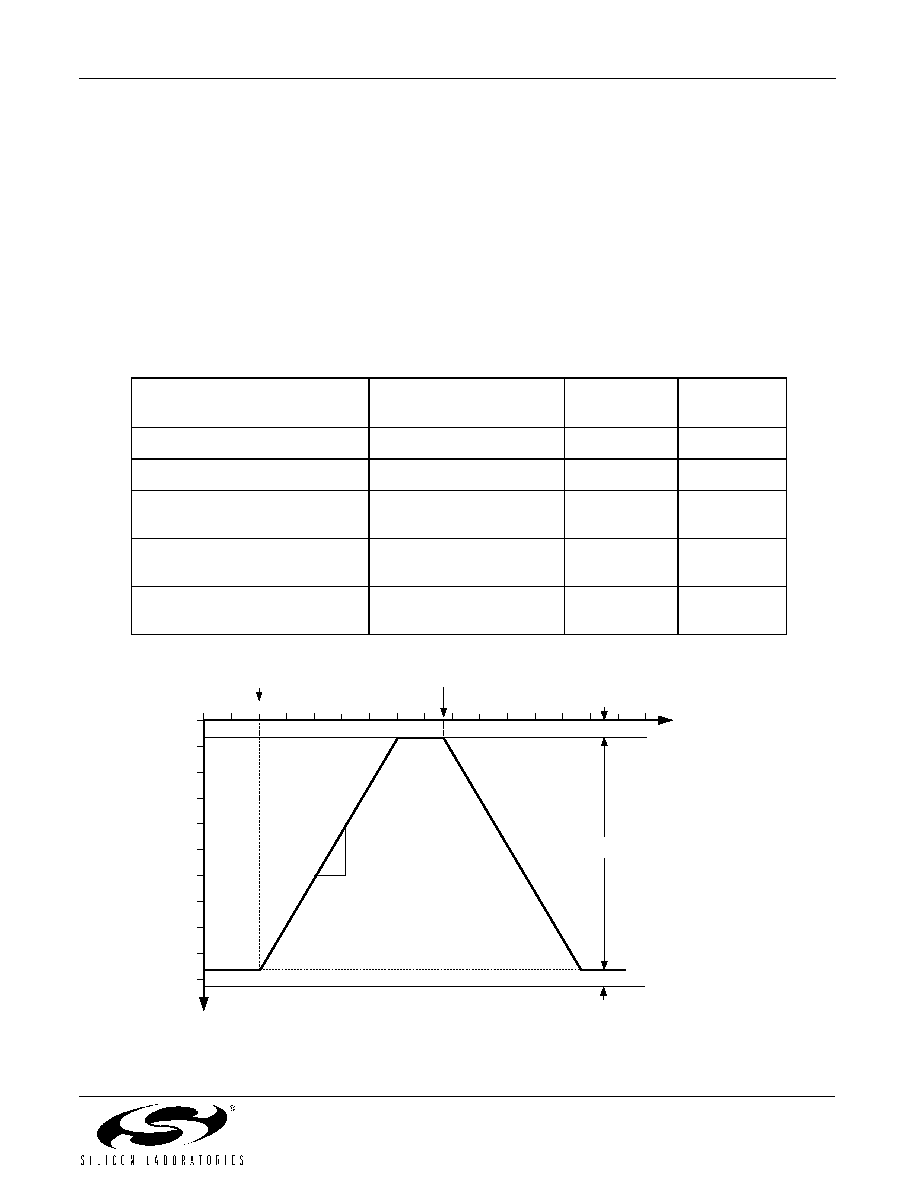
A wink function slowly ramps down the TIP-RING
voltage (VOC) to 1 followed by a return to the original
VOC value (set in the VOC RAM location). This scheme
lights a message-waiting lamp in certain handsets. No
change to the linefeed register is necessary to enable
this function. Instead, the user sets the VOCZERO bit to
1 so that the TIP-RING voltage collapses to 0 V at the
rate programmed by the RAMP bit. Setting the
VOCZERO bit back to 0 returns the TIP-RING voltage
to its normal setting. With a software timer, the user can
automate the cadence of the wink function. Figure 32
illustrates the wink function.
Figure 32. Wink Function with Programmable Ramp Rate
Table 33. Register and RAM Locations used for Polarity Reversal
Parameter
Programmable Range
Register/RAM
Bits
Register/RAM
Mnemonic
Linefeed
See Table 18
LF[2:0]
LINEFEED
Polarity Reversal Status
Read only
POLREV
Wink Function
(Smooth transition to Voc=0V)
1 = Ramp to 0 V
0 = Return to previous VOC
VOCZERO
POLREV
Smooth Polarity Reversal Enable
0 = Disabled
1 = Enabled
PREN
POLREV
Smooth Polarity Reversal Ramp
Rate
0=1V/125 s
1=2V/125 s
RAMP
POLREV
V
TIP/RING (V)
0
-10
-20
-30
-40
-50
Time (ms)
50
40
30
20
10
60
70
80
0
2 V/125 s slope
set by RAMP bit
Set VOCZERO bit to 1
Set VOCZERO bit to 0
V
cm
V
ov
V
oc
V
TIP
V
BAT
V
RING
相关PDF资料 |
PDF描述 |
|---|---|
| MCP120-315GI/TO | IC SUPERVISOR ACTIVE LOW TO-92 |
| MAX6439UTFJYD3+T | IC BATTERY MON SNGL SOT23-6 |
| LHL13TB221K | INDUCTOR 220UH 1.3A RADIAL |
| 1838240-1 | CONN MALE M12 3POS STR 2M CABLE |
| MCP120-300HI/TO | IC SUPERVISOR ACTIVE LOW TO-92 |
相关代理商/技术参数 |
参数描述 |
|---|---|
| SI3225PPT-EVB | 制造商:SILABS 制造商全称:SILABS 功能描述:EVALUATION BOARD FOR THE Si3225 DUAL PROSLIC |
| SI3225PPTX-EVB | 功能描述:音频 IC 开发工具 Si3225 Eval Board RoHS:否 制造商:Texas Instruments 产品:Evaluation Kits 类型:Audio Amplifiers 工具用于评估:TAS5614L 工作电源电压:12 V to 38 V |
| SI3225-X-FQ | 制造商:SILABS 制造商全称:SILABS 功能描述:DUAL PROSLIC㈢ PROGRAMMABLE CMOS SLIC/CODEC |
| SI3225-X-GQ | 制造商:SILABS 制造商全称:SILABS 功能描述:DUAL PROSLIC㈢ PROGRAMMABLE CMOS SLIC/CODEC |
| SI3226 | 制造商:SILABS 制造商全称:SILABS 功能描述:Dual ProSLIC㈢ with DC-DC Controller |
发布紧急采购,3分钟左右您将得到回复。