参数资料
| 型号: | XC2S15-6CS144C |
| 厂商: | Xilinx Inc |
| 文件页数: | 17/99页 |
| 文件大小: | 0K |
| 描述: | IC FPGA 2.5V C-TEMP 144-CSBGA |
| 标准包装: | 198 |
| 系列: | Spartan®-II |
| LAB/CLB数: | 96 |
| 逻辑元件/单元数: | 432 |
| RAM 位总计: | 16384 |
| 输入/输出数: | 86 |
| 门数: | 15000 |
| 电源电压: | 2.375 V ~ 2.625 V |
| 安装类型: | 表面贴装 |
| 工作温度: | 0°C ~ 85°C |
| 封装/外壳: | 144-TFBGA,CSPBGA |
| 供应商设备封装: | 144-LCSBGA(12x12) |
第1页第2页第3页第4页第5页第6页第7页第8页第9页第10页第11页第12页第13页第14页第15页第16页当前第17页第18页第19页第20页第21页第22页第23页第24页第25页第26页第27页第28页第29页第30页第31页第32页第33页第34页第35页第36页第37页第38页第39页第40页第41页第42页第43页第44页第45页第46页第47页第48页第49页第50页第51页第52页第53页第54页第55页第56页第57页第58页第59页第60页第61页第62页第63页第64页第65页第66页第67页第68页第69页第70页第71页第72页第73页第74页第75页第76页第77页第78页第79页第80页第81页第82页第83页第84页第85页第86页第87页第88页第89页第90页第91页第92页第93页第94页第95页第96页第97页第98页第99页
Spartan-II FPGA Family: Functional Description
DS001-2 (v2.8) June 13, 2008
Module 2 of 4
Product Specification
24
R
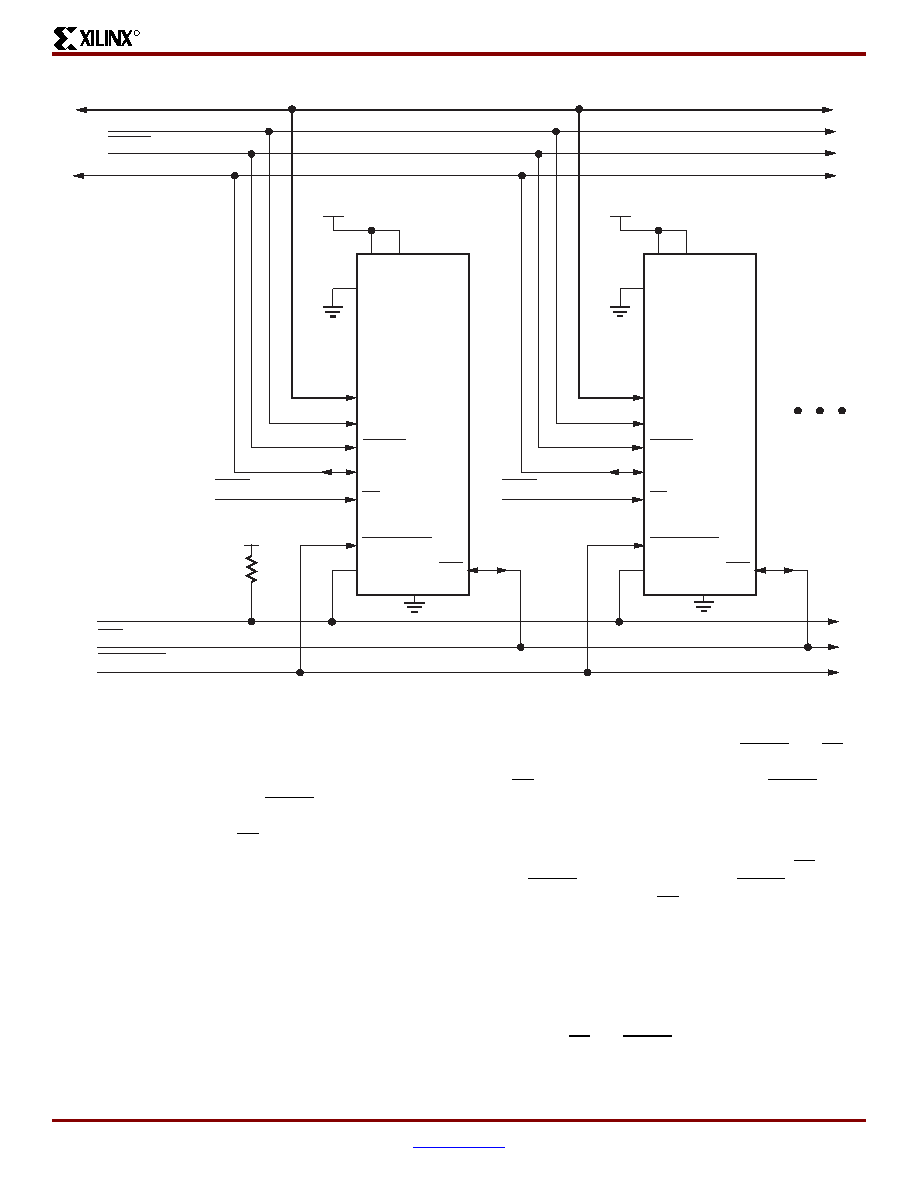
Multiple Spartan-II FPGAs can be configured using the
Slave Parallel mode, and be made to start-up
simultaneously. To configure multiple devices in this way,
wire the individual CCLK, Data, WRITE, and BUSY pins of
all the devices in parallel. The individual devices are loaded
separately by asserting the CS pin of each device in turn
and writing the appropriate data. Sync-to-DONE start-up
timing is used to ensure that the start-up sequence does not
begin until all the FPGAs have been loaded. See "Start-up,"
Write
When using the Slave Parallel Mode, write operations send
packets of byte-wide configuration data into the FPGA.
Figure 19, page 25 shows a flowchart of the write sequence
used to load data into the Spartan-II FPGA. This is an
expansion of the "Load Configuration Data Frames" block in
Figure 11, page 18. The timing for write operations is shown
For the present example, the user holds WRITE and CS
Low throughout the sequence of write operations. Note that
when CS is asserted on successive CCLKs, WRITE must
remain either asserted or de-asserted. Otherwise an abort
will be initiated, as in the next section.
1.
Drive data onto D0-D7. Note that to avoid contention,
the data source should not be enabled while CS is Low
and WRITE is High. Similarly, while WRITE is High, no
more than one device’s CS should be asserted.
2.
On the rising edge of CCLK: If BUSY is Low, the data is
accepted on this clock. If BUSY is High (from a previous
write), the data is not accepted. Acceptance will instead
occur on the first clock after BUSY goes Low, and the
data must be held until this happens.
3.
Repeat steps 1 and 2 until all the data has been sent.
4.
De-assert CS and WRITE.
Figure 18: Slave Parallel Configuration Circuit Diagram
M1 M2
M0
D0:D7
CCLK
WRITE
BUSY
CS
PROGRAM
DONEINIT
CCLK
DATA[7:0]
WRITE
BUSY
CS(0)
330
Ω
Spartan-II
FPGA
DONE
INIT
PROGRAM
M1 M2
M0
D0:D7
CCLK
WRITE
BUSY
CS
PROGRAM
DONEINIT
CS(1)
Spartan-II
FPGA
DS001_18_060608
GND
相关PDF资料 |
PDF描述 |
|---|---|
| XC2S15-5CS144I | IC FPGA 2.5V I-TEMP 144-CSBGA |
| XC2S15-5CS144C | IC FPGA 2.5V C-TEMP 144-CSBGA |
| XC2S100-5FG456I | IC FPGA 2.5V I-TEMP 456-FBGA |
| IDT71V35761S183PFG | IC SRAM 4MBIT 183MHZ 100TQFP |
| IDT71V35761S166PFG | IC SRAM 4MBIT 166MHZ 100TQFP |
相关代理商/技术参数 |
参数描述 |
|---|---|
| XC2S15-6CS144I | 制造商:XILINX 制造商全称:XILINX 功能描述:Spartan-II FPGA Family |
| XC2S15-6CSG144C | 制造商:XILINX 制造商全称:XILINX 功能描述:Spartan-II FPGA Family |
| XC2S15-6CSG144I | 制造商:XILINX 制造商全称:XILINX 功能描述:Spartan-II FPGA Family |
| XC2S15-6FG256C | 制造商:XILINX 制造商全称:XILINX 功能描述:Spartan-II FPGA Family |
| XC2S15-6FG256I | 制造商:XILINX 制造商全称:XILINX 功能描述:Spartan-II FPGA Family |
发布紧急采购,3分钟左右您将得到回复。