- 您现在的位置:买卖IC网 > PDF目录10627 > ADV7180BSTZ (Analog Devices Inc)IC VIDEO DECODER SDTV 64-LQFP PDF资料下载
参数资料
| 型号: | ADV7180BSTZ |
| 厂商: | Analog Devices Inc |
| 文件页数: | 93/116页 |
| 文件大小: | 0K |
| 描述: | IC VIDEO DECODER SDTV 64-LQFP |
| 产品变化通告: | ADV7180 Metal Mask Edit 22/Oct/2009 |
| 设计资源: | Low Cost Differential Video Receiver Using ADA4851 Amplifier and ADV7180 Video Decoder (CN0060) Low Cost Video Multiplexer for Video Switching Using ADA4853-2 Op Amp with Disable Function (CN0076) |
| 标准包装: | 1 |
| 类型: | 视频解码器 |
| 应用: | 数码相机,手机,便携式视频 |
| 安装类型: | 表面贴装 |
| 封装/外壳: | 64-LQFP |
| 供应商设备封装: | 64-LQFP(10x10) |
| 包装: | 托盘 |
| 产品目录页面: | 788 (CN2011-ZH PDF) |
| 配用: | EVAL-ADV7180LQEBZ-ND - BOARD EVALUATION ADV7180 EVAL-ADV7180LFEBZ-ND - BOARD EVAL FOR ADV7180 LFCSP |
第1页第2页第3页第4页第5页第6页第7页第8页第9页第10页第11页第12页第13页第14页第15页第16页第17页第18页第19页第20页第21页第22页第23页第24页第25页第26页第27页第28页第29页第30页第31页第32页第33页第34页第35页第36页第37页第38页第39页第40页第41页第42页第43页第44页第45页第46页第47页第48页第49页第50页第51页第52页第53页第54页第55页第56页第57页第58页第59页第60页第61页第62页第63页第64页第65页第66页第67页第68页第69页第70页第71页第72页第73页第74页第75页第76页第77页第78页第79页第80页第81页第82页第83页第84页第85页第86页第87页第88页第89页第90页第91页第92页当前第93页第94页第95页第96页第97页第98页第99页第100页第101页第102页第103页第104页第105页第106页第107页第108页第109页第110页第111页第112页第113页第114页第115页第116页
ADV7180
Data Sheet
Rev. I | Page 78 of 116
MPU PORT DESCRIPTION
Two inputs, serial data (SDATA) and serial clock (SCLK), carry
controller. Each slave device is recognized by a unique address.
the decoder and to read back the captured VBI data. The ADV7180
has four possible slave addresses for both read and write operations,
depending on the logic level of the ALSB pin. The four unique
addresses are shown in Table 104. The ADV7180 ALSB pin
controls Bit 1 of the slave address. By altering the ALSB, it is
possible to control two ADV7180s in an application without the
conflict of using the same slave address. The LSB (Bit 0) sets
either a read or write operation. Logic 1 corresponds to a read
operation, and Logic 0 corresponds to a write operation.
ALSB
R/W
Slave Address
0
0x40
0
1
0x41
1
0
0x42
1
0x43
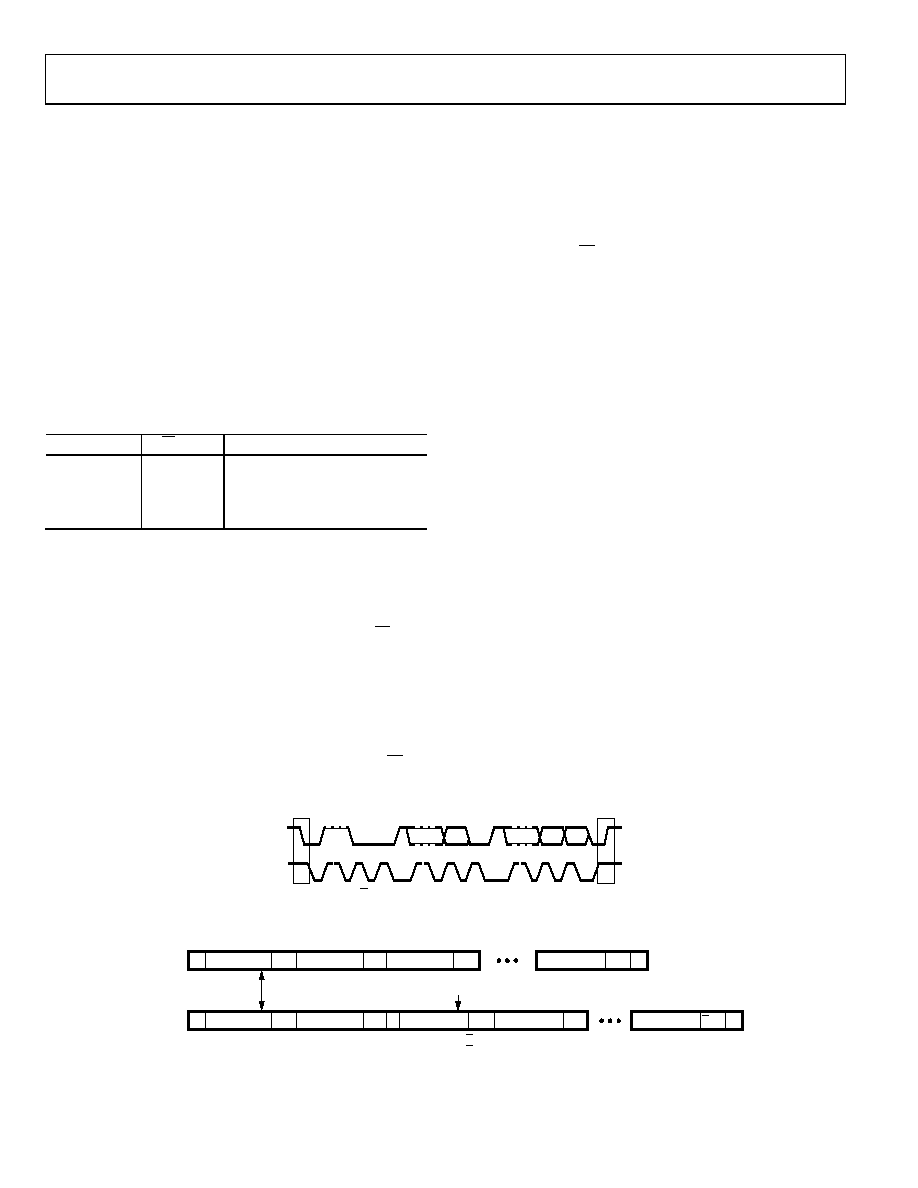
To control the device on the bus, a specific protocol must be
followed. First, the master initiates a data transfer by establishing a
start condition, which is defined by a high-to-low transition on
SDATA while SCLK remains high. This indicates that an address/
data stream follows. All peripherals respond to the start condition
and shift the next eight bits (the 7-bit address plus the R/W bit).
The bits are transferred from MSB down to LSB. The peripheral
that recognizes the transmitted address responds by pulling the
data line low during the ninth clock pulse; this is known as an
acknowledge bit. All other devices withdraw from the bus at
this point and maintain an idle condition. The idle condition is
where the device monitors the SDATA and SCLK lines for the
start condition and the correct transmitted address. The R/W
bit determines the direction of the data. Logic 0 on the LSB of
the first byte means that the master writes information to the
peripheral. Logic 1 on the LSB of the first byte means that the
master reads information from the peripheral.
The ADV7180 acts as a standard slave device on the bus. The
data on the SDATA pin is eight bits long, supporting the 7-bit
address plus the R/W bit. The device has 249 subaddresses to
enable access to the internal registers. Therefore, it interprets
the first byte as the device address and the second byte as the
starting subaddress. The subaddresses auto-increment, allowing
data to be written to or read from the starting subaddress. A data
transfer is always terminated by a stop condition. The user can
also access any unique subaddress register on a one-by-one
basis without updating all the registers.
Stop and start conditions can be detected at any stage during the
data transfer. If these conditions are asserted out of sequence with
normal read and write operations, they cause an immediate jump
to the idle condition. During a given SCLK high period, the user
should only issue one start condition, one stop condition, or a
single stop condition followed by a single start condition. If an
invalid subaddress is issued by the user, the ADV7180 does not
issue an acknowledge and returns to the idle condition.
In auto-increment mode, if the user exceeds the highest
subaddress, the following action is taken:
In read mode, the highest subaddress register contents
continue to be output until the master device issues a no
acknowledge. This indicates the end of a read. A no
acknowledge condition occurs when the SDATA line is
not pulled low on the ninth pulse.
In write mode, the data for the invalid byte is not loaded
into any subaddress register. A no acknowledge is issued by
the ADV7180, and the part returns to the idle condition.
SDATA
SCLK
START ADDR
ACK
DATA
ACK
STOP
SUBADDRESS
1–7
8
9
8
9
1–7
8
9
S
P
R/W
05
70
0-
04
4
Figure 53. Bus Data Transfer
S
WRITE
SEQUENCE
SLAVE ADDR
A(S)
SUB ADDR
A(S)
DATA
A(S)
DATA
A(S)
P
S
READ
SEQUENCE
SLAVE ADDR
A(S)
SUB ADDR
A(S) S
A(S)
DATA
A(M)
DATA
A(M) P
S = START BIT
P= STOP BIT
A(S) = ACKNOWLEDGE BY SLAVE
A(M) = ACKNOWLEDGE BY MASTER
A(S) = NO ACKNOWLEDGE BY SLAVE
A(M) = NO ACKNOWLEDGE BY MASTER
LSB = 1
LSB = 0
057
00
-04
5
Figure 54. Read and Write Sequence
相关PDF资料 |
PDF描述 |
|---|---|
| VI-BWR-MX-F3 | CONVERTER MOD DC/DC 7.5V 75W |
| VE-2W3-IW-F1 | CONVERTER MOD DC/DC 24V 100W |
| ADV7611BSWZ-P | IC RCVR HDMI 165MHZ LP 64LQFP |
| MAX3483ECPA+ | IC TXRX RS485/422 250KBPS 8-DIP |
| VI-BWR-MX-F1 | CONVERTER MOD DC/DC 7.5V 75W |
相关代理商/技术参数 |
参数描述 |
|---|---|
| ADV7180BSTZ | 制造商:Analog Devices 功能描述:Video IC |
| ADV7180BSTZ-REEL | 功能描述:IC VIDEO DECODER SDTV 64-LQFP RoHS:是 类别:集成电路 (IC) >> 线性 - 视频处理 系列:- 标准包装:250 系列:- 类型:电平移位器 应用:LCD 电视机/监控器 安装类型:表面贴装 封装/外壳:28-WFQFN 裸露焊盘 供应商设备封装:28-WQFN(4x4)裸露焊盘 包装:带卷 (TR) 其它名称:296-32523-2TPS65198RUYT-ND |
| ADV7180KCP32Z | 功能描述:IC VIDEO DECODER 10BIT 32LFCSP RoHS:是 类别:集成电路 (IC) >> 线性 - 视频处理 系列:- 产品变化通告:Product Discontinuation 07/Mar/2011 标准包装:3,000 系列:OMNITUNE™ 类型:调谐器 应用:移动电话,手机,视频显示器 安装类型:表面贴装 封装/外壳:65-WFBGA 供应商设备封装:PG-WFSGA-65 包装:带卷 (TR) 其它名称:SP000365064 |
| ADV7180KCP32Z-RL | 功能描述:IC VIDEO DECODER 10BIT 32LFCSP RoHS:是 类别:集成电路 (IC) >> 线性 - 视频处理 系列:- 产品变化通告:Product Discontinuation 07/Mar/2011 标准包装:3,000 系列:OMNITUNE™ 类型:调谐器 应用:移动电话,手机,视频显示器 安装类型:表面贴装 封装/外壳:65-WFBGA 供应商设备封装:PG-WFSGA-65 包装:带卷 (TR) 其它名称:SP000365064 |
| ADV7180KST48Z | 功能描述:IC VID DECOD SDTV 10BIT 48LQFP RoHS:是 类别:集成电路 (IC) >> 线性 - 视频处理 系列:- 产品变化通告:Product Discontinuation 07/Mar/2011 标准包装:3,000 系列:OMNITUNE™ 类型:调谐器 应用:移动电话,手机,视频显示器 安装类型:表面贴装 封装/外壳:65-WFBGA 供应商设备封装:PG-WFSGA-65 包装:带卷 (TR) 其它名称:SP000365064 |
发布紧急采购,3分钟左右您将得到回复。