参数资料
| 型号: | ISL8107IRZ |
| 厂商: | Intersil |
| 文件页数: | 14/16页 |
| 文件大小: | 0K |
| 描述: | IC REG CTRLR BUCK PWM VM 16-QFN |
| 标准包装: | 60 |
| PWM 型: | 电压模式 |
| 输出数: | 1 |
| 频率 - 最大: | 600kHz |
| 电源电压: | 9 V ~ 75 V |
| 降压: | 是 |
| 升压: | 无 |
| 回扫: | 无 |
| 反相: | 无 |
| 倍增器: | 无 |
| 除法器: | 无 |
| Cuk: | 无 |
| 隔离: | 无 |
| 工作温度: | -40°C ~ 85°C |
| 封装/外壳: | 16-VQFN 裸露焊盘 |
| 包装: | 管件 |
ISL8107
6. Calculate R 1 such that the placement of F Z2 is at the F LC .
R 1 = -------------------------------------- – R 3
1
2 π × C 3 × F LC
(EQ. 18)
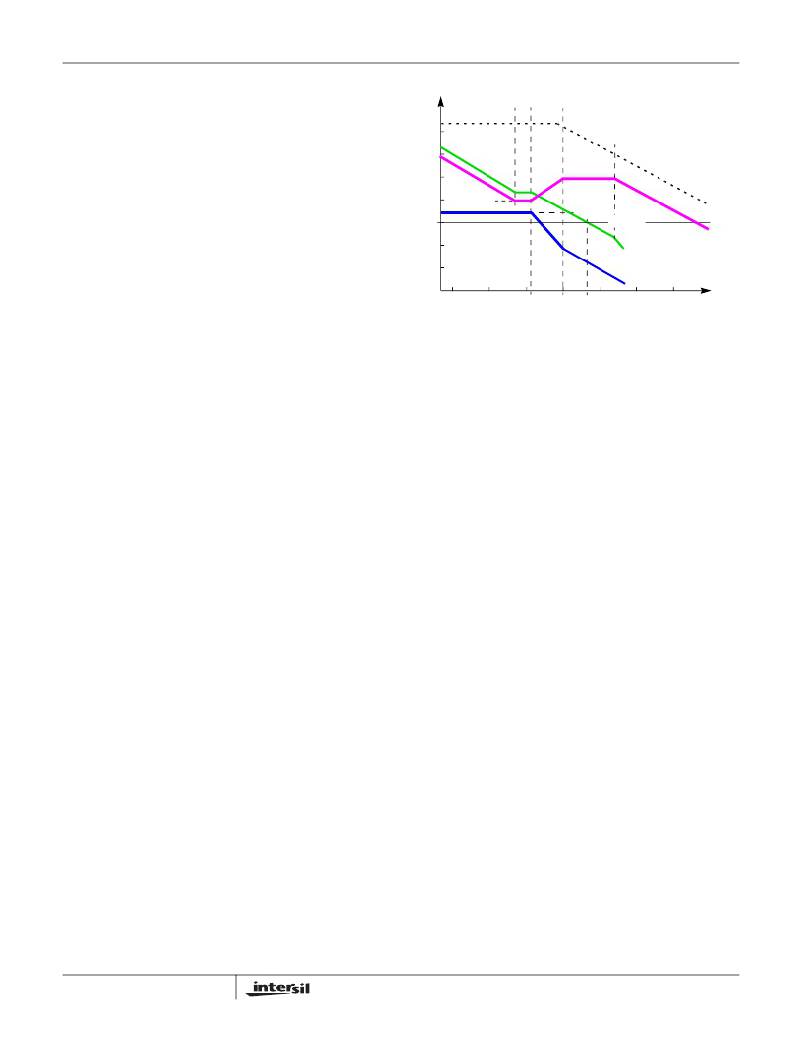
F Z1 F Z2
F P1
MODULATOR GAIN
COMPENSATION GAIN
LOOP GAIN
OPEN LOOP E/A GAIN
R 4 = ------------------------------------- × R 1
7. Calculate R 4 based on target output voltage.
V REF
V OUT – V REF
(EQ. 19)
F P2
20 log ? -------- ?
MAX ? V IN
OSC
It is recommended that a mathematical model be used to
plot the loop response. Check the loop gain against the error
amplifier ’s open-loop gain. Verify phase margin results and
adjust as necessary. Equations 20 and 21 describe the
0
R2
? R1 ?
D
20 log ----------------------------------
V
G CL
G FB
frequency response of the buck converter in continuous
conduction mode (G vd ), feedback compensation (G comp )
and loop response (G LP ):
LOG
F LC
F CE
F 0
G MOD
FREQUENCY
G vd ( f ) = ------------------------------- ? -----------------------------------------------------------------------------------------------------------
V OSC
1 + s ( f ) ? ( ESR + DCR ) ? C + s ( f ) ? L ? C
D MAX ? V IN 1 + s ( f ) ? ESR ? C
2
FIGURE 16. ASYMPTOTIC BODE PLOT OF CONVERTER GAIN
target crossover frequencies in the range of 10% to 30% of
1 + s ( f ) ? R 2 ? C 1
s ( f ) ? R 1 ? ( C 1 + C 2 )
1 + s ( f ) ? ( R 1 + R 3 ) ? C 3
( 1 + s ( f ) ? R 3 ? C 3 ) ? ? 1 + s ( f ) ? R 2 ? --------------------- ?
G COMP ( f ) = ---------------------------------------------------- ?
--------------------------------------------------------------------------------------------------------------------
? C 1 ? C 2 ?
? C 1 + C 2 ?
(EQ. 20)
the switching frequency (F SW ).
Layout Considerations
As in any high frequency switching converter, layout is very
important. Switching current from one power device to
another can generate voltage transients across the
impedances of the interconnecting bond wires and circuit
G LP ( f ) = G vd ( f ) ? G COMP ( f )
where , s ( f ) = 2 π ? f ? j
traces. These interconnecting impedances should be
minimized by using wide, short printed circuit traces. The
COMPENSATION BREAK FREQUENCY EQUATIONS
critical components should be located as close together as
possible using ground plane construction or single point
F Z1 = -------------------------------
F Z2 = -------------------------------------------------
F P1 = -------------------------------
F P2 = ---------------------------------------------
2 π ? R 2 ? ---------------------
1
2 π ? R 2 ? C 1
1
2 π ? ( R 1 + R 3 ) ? C 3
1
2 π ? R 3 ? C 3
1
C 1 ? C 2
C 1 + C 2
(EQ. 21)
grounding.
A multi-layer printed circuit board is recommended.
Figure 17 shows the critical components of the converter.
Note that capacitors C IN and C OUT could each represent
numerous physical capacitors. Dedicate one solid layer,
(usually a middle layer of the PC board) for a ground plane
Figure 16 shows an asymptotic plot of the DC/DC converter’s
gain vs frequency. The actual Modulator Gain has a high gain
peak dependent on the quality factor (Q) of the output filter,
which is not shown. Using the previous guidelines should yield
a compensation gain similar to the curve plotted. The open loop
error amplifier gain bounds the compensation gain. Check the
compensation gain at F P2 against the capabilities of the error
amplifier. The loop gain, G LP , is constructed on the log-log
graph of Figure 16 by adding the modulator gain, G vd (in
dB), to the feedback compensation gain, G COMP (in dB).
This is equivalent to multiplying the modulator transfer
function and the compensation transfer function and then
plotting the resulting gain.
A stable control loop has a gain crossing with close to a
-20dB/decade slope and a phase margin greater than 45°.
Include worst case component variations when determining
phase margin. The mathematical model presented makes a
number of approximations and is generally not accurate at
frequencies approaching or exceeding half the switching
frequency. When designing compensation networks, select
14
and make all critical component ground connections with
vias to this layer. Dedicate another solid layer as a power
plane and break this plane into smaller islands of common
voltage levels. Keep the metal runs from the PHASE
terminals to the output inductor short. The power plane
should support the input power and output power nodes.
Use copper filled polygons on the top and bottom circuit
layers for the PHASE nodes. Use the remaining printed
circuit layers for small signal wiring.
FN6605.0
October 29, 2008
相关PDF资料 |
PDF描述 |
|---|---|
| ISL8118IRZ-T | IC REG CTRLR BUCK PWM VM 28-QFN |
| ISL8120IRZEC | IC REG CTRLR BUCK PWM VM 32-QFN |
| ISL8120IRZ | IC REG CTRLR BUCK PWM VM 32-QFN |
| ISL8121IRZ | IC REG CTRLR BUCK PWM VM 24-QFN |
| ISL8126IRZ | IC REG CTRLR BUCK PWM VM 32-QFN |
相关代理商/技术参数 |
参数描述 |
|---|---|
| ISL8107IRZ-T | 功能描述:IC REG CTRLR BUCK PWM VM 16-QFN RoHS:是 类别:集成电路 (IC) >> PMIC - 稳压器 - DC DC 切换控制器 系列:- 产品培训模块:Lead (SnPb) Finish for COTS Obsolescence Mitigation Program 标准包装:2,500 系列:- PWM 型:电流模式 输出数:1 频率 - 最大:275kHz 占空比:50% 电源电压:18 V ~ 110 V 降压:无 升压:无 回扫:无 反相:无 倍增器:无 除法器:无 Cuk:无 隔离:是 工作温度:-40°C ~ 85°C 封装/外壳:8-SOIC(0.154",3.90mm 宽) 包装:带卷 (TR) |
| ISL8112 | 制造商:INTERSIL 制造商全称:Intersil Corporation 功能描述:High Light-Load Efficiency, Dual-Output, Main Power Supply Controllers |
| ISL8112EVAL1Z | 功能描述:EVALUATION BOARD FOR ISL8112 RoHS:是 类别:编程器,开发系统 >> 评估板 - DC/DC 与 AC/DC(离线)SMPS 系列:- 产品培训模块:Obsolescence Mitigation Program 标准包装:1 系列:True Shutdown™ 主要目的:DC/DC,步升 输出及类型:1,非隔离 功率 - 输出:- 输出电压:- 电流 - 输出:1A 输入电压:2.5 V ~ 5.5 V 稳压器拓扑结构:升压 频率 - 开关:3MHz 板类型:完全填充 已供物品:板 已用 IC / 零件:MAX8969 |
| ISL8112IRZ | 功能描述:IC REG DL BCK/LINEAR SYNC 32-QFN RoHS:是 类别:集成电路 (IC) >> PMIC - 稳压器 - 线性 + 切换式 系列:- 标准包装:2,500 系列:- 拓扑:降压(降压)同步(3),线性(LDO)(2) 功能:任何功能 输出数:5 频率 - 开关:300kHz 电压/电流 - 输出 1:控制器 电压/电流 - 输出 2:控制器 电压/电流 - 输出 3:控制器 带 LED 驱动器:无 带监控器:无 带序列发生器:是 电源电压:5.6 V ~ 24 V 工作温度:-40°C ~ 85°C 安装类型:* 封装/外壳:* 供应商设备封装:* 包装:* |
发布紧急采购,3分钟左右您将得到回复。