参数资料
| 型号: | AD7631BCPZ |
| 厂商: | Analog Devices Inc |
| 文件页数: | 20/32页 |
| 文件大小: | 0K |
| 描述: | IC ADC 18BIT 250KSPS BIP 48LFCSP |
| 标准包装: | 1 |
| 系列: | PulSAR® |
| 位数: | 18 |
| 采样率(每秒): | 250k |
| 数据接口: | 串行,并联 |
| 转换器数目: | 1 |
| 功率耗散(最大): | 120mW |
| 电压电源: | 模拟和数字 |
| 工作温度: | -40°C ~ 85°C |
| 安装类型: | 表面贴装 |
| 封装/外壳: | 48-VFQFN 裸露焊盘,CSP |
| 供应商设备封装: | 48-LFCSP-VQ(7x7) |
| 包装: | 托盘 |
| 输入数目和类型: | 1 个差分,单极;1 个差分,双极 |
第1页第2页第3页第4页第5页第6页第7页第8页第9页第10页第11页第12页第13页第14页第15页第16页第17页第18页第19页当前第20页第21页第22页第23页第24页第25页第26页第27页第28页第29页第30页第31页第32页
Data Sheet
AD7631
Rev. B | Page 27 of 32
External Discontinuous Clock Data Read After
Conversion
Though the maximum throughput cannot be achieved using
this mode, it is the most recommended of the serial slave modes.
Figure 44 shows the detailed timing diagrams for this method.
After a conversion is completed, indicated by BUSY returning low,
the conversion result can be read while both CS and RD are low.
Data is shifted out MSB first with 18 clock pulses and, depending
on the SDCLK frequency, can be valid on the falling and rising
edges of the clock.
One advantage of this method is that conversion performance is
not degraded because there are no voltage transients on the digital
interface during the conversion process. Another advantage is
the ability to read the data at any speed up to 40 MHz, which
accommodates both the slow digital host interface and the fastest
serial reading.
Daisy-Chain Feature
In addition, in the read after convert mode, the AD7631 provides a
daisy-chain feature for cascading multiple converters together
using the serial data input pin, SDIN. This feature is useful for
reducing component count and wiring connections when desired,
for instance, in isolated multiconverter applications. See Figure 44
for the timing details.
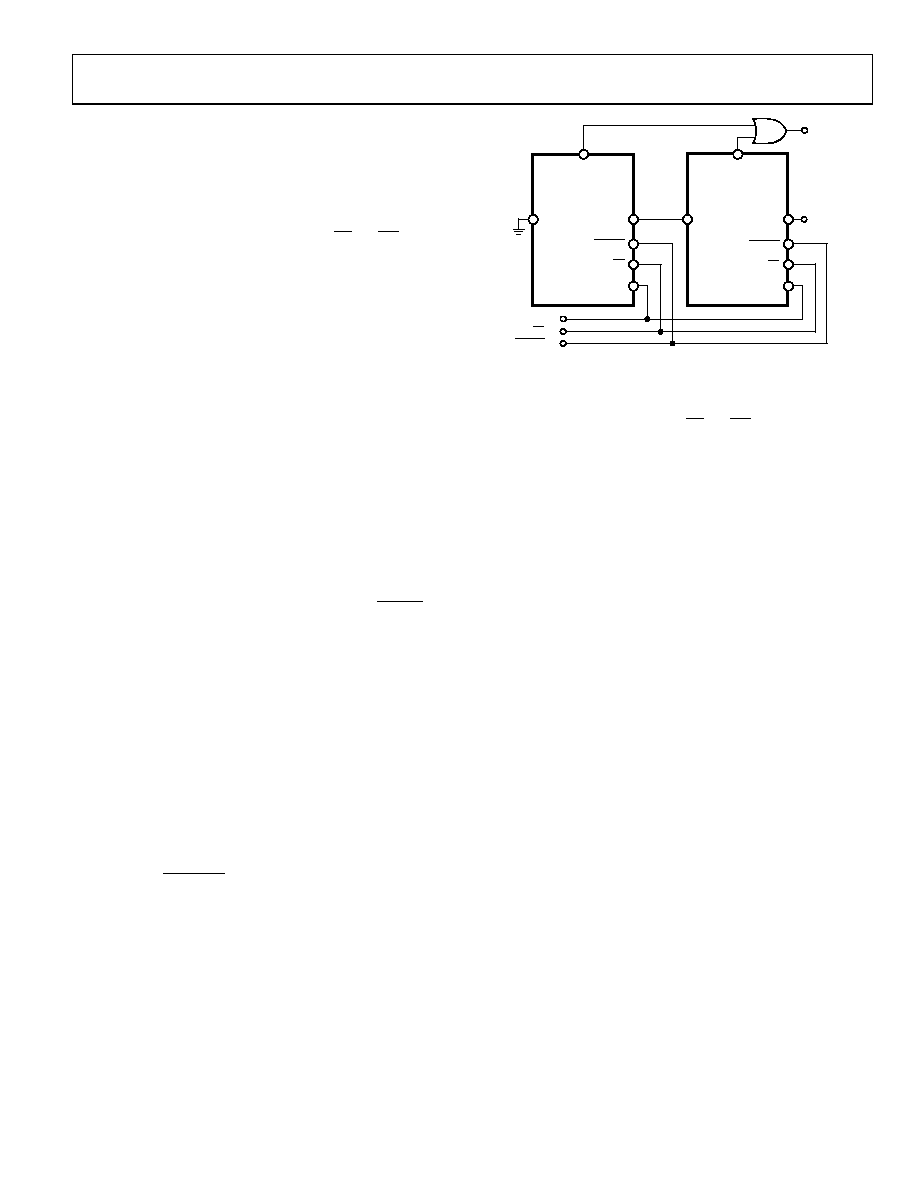
An example of the concatenation of two devices is shown
in Figure 43.
Simultaneous sampling is possible by using a common CNVST
signal. Note that the SDIN input is latched on the opposite edge
of SDCLK used to shift out the data on SDOUT (SDCLK
falling edge when INVSCLK = low). Therefore, the MSB of
the upstream converter follows the LSB of the downstream
converter on the next SDCLK cycle. In this mode, the 40 MHz
SDCLK rate cannot be used because the SDIN to SDCLK setup
time, t33, is less than the minimum time specified. (SDCLK
to SDOUT delay, t32, is the same for all converters when
simultaneously sampled). For proper operation, the SDCLK
edge for latching SDIN (or period of SDCLK) needs to be
33
32
SDCLK
t
2
/
1
Or the maximum SDCLK frequency needs to be
)
(
2
1
33
32
SDCLK
t
f
If not using the daisy-chain feature, the SDIN input should
always be tied either high or low.
SDCLK
SDOUT
RDC/SDIN
AD7631
#1
(DOWNSTREAM)
AD7631
#2
(UPSTREAM)
BUSY
OUT
BUSY
DATA
OUT
SDCLK
RDC/SDIN SDOUT
SDCLK IN
CNVST IN
CNVST
CS
CNVST
CS
CS IN
0
65
88
-04
3
Figure 43. Two AD7631 Devices in a Daisy-Chain Configuration
External Clock Data Read During Previous Conversion
Figure 45 shows the detailed timing diagrams for this method.
During a conversion, while both CS and RD are low, the result
of the previous conversion can be read. The data is shifted out,
MSB first, with 18 clock pulses and is valid on both the falling
and rising edges of the clock. The 18 bits have to be read before
the current conversion is completed; otherwise, RDERROR is
pulsed high and can be used to interrupt the host interface to
prevent incomplete data reading.
To reduce performance degradation due to digital activity, a fast
discontinuous clock of at least 40 MHz is recommended to ensure
that all the bits are read during the first half of the SAR
conversion phase.
The daisy-chain feature should not be used in this mode because
digital activity occurs during the second half of the SAR
conversion phase likely resulting in performance degradation.
External Clock Data Read After/During Conversion
It is also possible to begin to read data after conversion and
continue to read the last bits after a new conversion is initiated.
This method allows the full throughput and the use of a slower
SDCLK frequency. Again, it is recommended to use a
discontinuous SDCLK whenever possible to minimize
potential incorrect bit decisions. The use of a slower SDCLK,
such as 13 MHz, can be used.
相关PDF资料 |
PDF描述 |
|---|---|
| AD7634BCPZ | IC ADC 18BIT BIPO PROGR 48-LFCSP |
| AD7641BSTZRL | IC ADC 18BIT 2MSPS SAR 48-LQFP |
| AD7643BCPZ | IC ADC 18BIT DIFF W/REF 48LFCSP |
| AD7650ACPZ | IC ADC 16BIT CMOS 5V 48LFCSP |
| AD7651ACPZ | IC ADC 16BIT UNIPOLAR 48LFCSP |
相关代理商/技术参数 |
参数描述 |
|---|---|
| AD7631BCPZRL | 功能描述:IC ADC 18BIT 250KSPS BIP 48LFCSP RoHS:是 类别:集成电路 (IC) >> 数据采集 - 模数转换器 系列:PulSAR® 标准包装:1 系列:- 位数:14 采样率(每秒):83k 数据接口:串行,并联 转换器数目:1 功率耗散(最大):95mW 电压电源:双 ± 工作温度:0°C ~ 70°C 安装类型:通孔 封装/外壳:28-DIP(0.600",15.24mm) 供应商设备封装:28-PDIP 包装:管件 输入数目和类型:1 个单端,双极 |
| AD7631BSTZ | 功能描述:IC ADC 18BIT 250KSPS BIP 48-LQFP RoHS:是 类别:集成电路 (IC) >> 数据采集 - 模数转换器 系列:PulSAR® 其它有关文件:TSA1204 View All Specifications 标准包装:1 系列:- 位数:12 采样率(每秒):20M 数据接口:并联 转换器数目:2 功率耗散(最大):155mW 电压电源:模拟和数字 工作温度:-40°C ~ 85°C 安装类型:表面贴装 封装/外壳:48-TQFP 供应商设备封装:48-TQFP(7x7) 包装:Digi-Reel® 输入数目和类型:4 个单端,单极;2 个差分,单极 产品目录页面:1156 (CN2011-ZH PDF) 其它名称:497-5435-6 |
| AD7631BSTZRL | 功能描述:IC ADC 18BIT 250KSPS BIP 48-LQFP RoHS:是 类别:集成电路 (IC) >> 数据采集 - 模数转换器 系列:PulSAR® 标准包装:1 系列:- 位数:14 采样率(每秒):83k 数据接口:串行,并联 转换器数目:1 功率耗散(最大):95mW 电压电源:双 ± 工作温度:0°C ~ 70°C 安装类型:通孔 封装/外壳:28-DIP(0.600",15.24mm) 供应商设备封装:28-PDIP 包装:管件 输入数目和类型:1 个单端,双极 |
| AD7634 | 制造商:AD 制造商全称:Analog Devices 功能描述:14-Bit, 1 MSPS, Differential, Programmable Input PulSAR ADC |
| AD7634BCPZ | 功能描述:IC ADC 18BIT BIPO PROGR 48-LFCSP RoHS:是 类别:集成电路 (IC) >> 数据采集 - 模数转换器 系列:PulSAR® 标准包装:1 系列:- 位数:14 采样率(每秒):83k 数据接口:串行,并联 转换器数目:1 功率耗散(最大):95mW 电压电源:双 ± 工作温度:0°C ~ 70°C 安装类型:通孔 封装/外壳:28-DIP(0.600",15.24mm) 供应商设备封装:28-PDIP 包装:管件 输入数目和类型:1 个单端,双极 |
发布紧急采购,3分钟左右您将得到回复。