- 您现在的位置:买卖IC网 > PDF目录80167 > L99PM62XPTR (STMICROELECTRONICS) 4-CHANNEL POWER SUPPLY MANAGEMENT CKT, PDSO36 PDF资料下载
参数资料
| 型号: | L99PM62XPTR |
| 厂商: | STMICROELECTRONICS |
| 元件分类: | 电源管理 |
| 英文描述: | 4-CHANNEL POWER SUPPLY MANAGEMENT CKT, PDSO36 |
| 封装: | ROHS COMPLIANT, POWERSSO-36 |
| 文件页数: | 14/98页 |
| 文件大小: | 1117K |
| 代理商: | L99PM62XPTR |
第1页第2页第3页第4页第5页第6页第7页第8页第9页第10页第11页第12页第13页当前第14页第15页第16页第17页第18页第19页第20页第21页第22页第23页第24页第25页第26页第27页第28页第29页第30页第31页第32页第33页第34页第35页第36页第37页第38页第39页第40页第41页第42页第43页第44页第45页第46页第47页第48页第49页第50页第51页第52页第53页第54页第55页第56页第57页第58页第59页第60页第61页第62页第63页第64页第65页第66页第67页第68页第69页第70页第71页第72页第73页第74页第75页第76页第77页第78页第79页第80页第81页第82页第83页第84页第85页第86页第87页第88页第89页第90页第91页第92页第93页第94页第95页第96页第97页第98页
L99PM62XP
Description
Doc ID 16363 Rev 2
Section 2.2.8: Timer interrupt / wake-up of microcontroller by timer). After wake-up, the
watchdog starts with a long open window. After serving the watchdog, the C may send the
device back to V1 standby mode.
After power-on or standby mode, the watchdog is started with a long open window (65 ms
nominal). The long open window allows the micro controller to run its own setup and then to
trigger the watchdog via the SPI. The trigger is processed when the CSN input becomes
HIGH after the transmission of the SPI word.
Writing ‘1’ to the watchdog trigger bit terminates the long open window and start the window
watchdog (the timing is programmable by SPI). Subsequently, the micro controller has to
serve the watchdog by alternating the watchdog trigger bit within the safe trigger area (refer
to Figure 27). A correct watchdog trigger signal is immediately start the next cycle.
After 8 watchdog failures in sequence, the V1 regulator is switched off for 200ms. If
subsequently, 7 additional watchdog failures occur, the V1 regulator is completely turned off
and the device goes into VBAT standby mode until a wakeup occurs.
In case of a watchdog failure, the outputs (RELx, OUTx, V2) are switched off and the device
enters fail-safe mode (i. e. all control registers are set to default values except the ‘OUT3
control bit’).
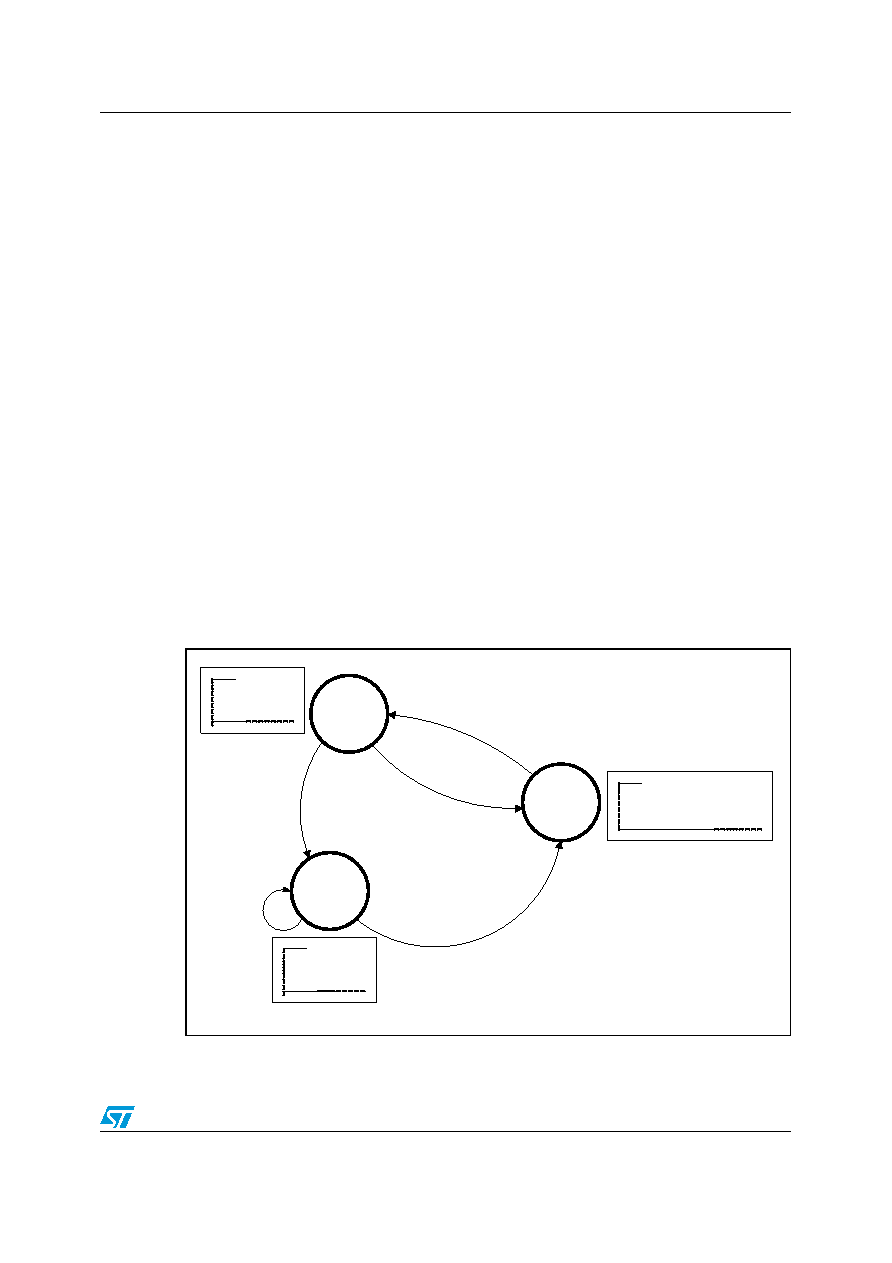
The following diagrams illustrate the watchdog behavior of the L99PM62. The diagrams are
split into 3 parts. First diagram shows the functional behavior of the watchdog without any
error. The second diagram covers the behavior covering all the error conditions, which can
affect the watchdog behavior. Third diagram shows the transition in and out of Flash mode.
All 3 diagrams can be overlapped to get all the possible state transitions under all
circumstances. For a better readability, they were split in normal operating, operating with
errors and Flash mode.
Figure 9.
Watchdog in normal operating mode (no errors)
WD
OFF
long
open
window
Window
Mode
propper trigger in
Window mode
TRIG = 1'
go Standby
V1 > Vrstthr
VBAT Standby
V1 Standby (I(V1) < ICMP)
Active mode
相关PDF资料 |
PDF描述 |
|---|---|
| LSN-1.8/10-D3J | 1-OUTPUT DC-DC REG PWR SUPPLY MODULE |
| LSN-1.25/10-D3B | 1-OUTPUT DC-DC REG PWR SUPPLY MODULE |
| LS4601-7EPD7TB1 | 1-OUTPUT 100 W AC-DC PWR FACTOR CORR MODULE |
| LS5540-7ERD9TB1 | 2-OUTPUT 100 W AC-DC PWR FACTOR CORR MODULE |
| LS5540-7ERD5TB1 | 2-OUTPUT 100 W AC-DC PWR FACTOR CORR MODULE |
相关代理商/技术参数 |
参数描述 |
|---|---|
| L99PM72GXPTR | 功能描述:Automotive PMIC PowerSSO-36 制造商:stmicroelectronics 系列:- 包装:剪切带(CT) 零件状态:有效 应用:汽车级 电流 - 电源:6mA 电压 - 电源:6 V ~ 18 V 工作温度:-40°C ~ 130°C 安装类型:表面贴装 封装/外壳:36-??FSOP(0.295",7.50mm 宽) 供应商器件封装:PowerSSO-36 标准包装:1 |
| L99SD01-E | 制造商:STMicroelectronics 功能描述:ABD VIPOWER - Rail/Tube |
| L99SD01TR-E | 制造商:STMicroelectronics 功能描述:ABD VIPOWER - Tape and Reel |
| L9A0212 | 制造商:LSI 制造商全称:LSI 功能描述:Microprocessor |
| L9D112G80BG4 | 制造商:LOGIC 制造商全称:LOGIC 功能描述:1.2 Gb, DDR - SDRAM Integrated Module |
发布紧急采购,3分钟左右您将得到回复。