- 您现在的位置:买卖IC网 > PDF目录67988 > MCV18E-I/P 32-BIT, FLASH, 20 MHz, RISC MICROCONTROLLER, PDIP18 PDF资料下载
参数资料
| 型号: | MCV18E-I/P |
| 元件分类: | 微控制器/微处理器 |
| 英文描述: | 32-BIT, FLASH, 20 MHz, RISC MICROCONTROLLER, PDIP18 |
| 封装: | 0.300 INCH, LEAD FREE, PLASTIC, DIP-18 |
| 文件页数: | 22/108页 |
| 文件大小: | 1509K |
| 代理商: | MCV18E-I/P |
第1页第2页第3页第4页第5页第6页第7页第8页第9页第10页第11页第12页第13页第14页第15页第16页第17页第18页第19页第20页第21页当前第22页第23页第24页第25页第26页第27页第28页第29页第30页第31页第32页第33页第34页第35页第36页第37页第38页第39页第40页第41页第42页第43页第44页第45页第46页第47页第48页第49页第50页第51页第52页第53页第54页第55页第56页第57页第58页第59页第60页第61页第62页第63页第64页第65页第66页第67页第68页第69页第70页第71页第72页第73页第74页第75页第76页第77页第78页第79页第80页第81页第82页第83页第84页第85页第86页第87页第88页第89页第90页第91页第92页第93页第94页第95页第96页第97页第98页第99页第100页第101页第102页第103页第104页第105页第106页第107页第108页
MCV18E
DS41399A-page 20
2009 Microchip Technology Inc.
2.5
Indirect Addressing, INDF and
FSR Registers
The INDF register is not a physical register. Addressing
INDF actually addresses the register whose address is
contained in the FSR register (FSR is a pointer). This is
indirect addressing.
EXAMPLE 2-1:
INDIRECT ADDRESSING
Register file 05 contains the value 10h
Register file 06 contains the value 0Ah
Load the value 05 into the FSR register
A read of the INDF register will return the value of
10h
Increment the value of the FSR register by one
(FSR = 06)
A read of the INDR register now will return the
value of 0Ah.
Reading INDF itself indirectly (FSR = 0) will produce
00h. Writing to the INDF register indirectly results in a
no-operation (although Status bits may be affected).
A simple program to clear RAM locations 20h-2Fh
using indirect addressing is shown in Example 2-2.
EXAMPLE 2-2:
HOW TO CLEAR RAM
USING INDIRECT
ADDRESSING
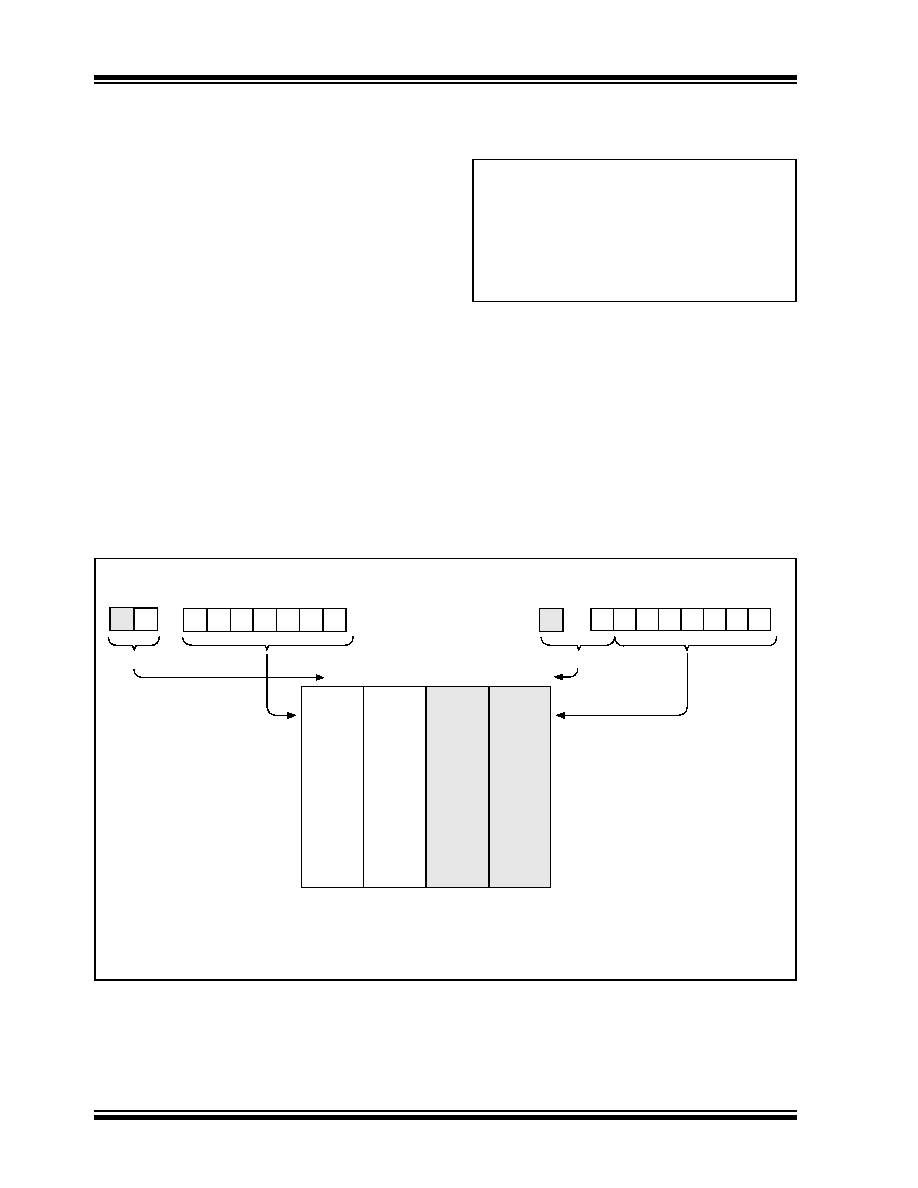
An effective 9-bit address is obtained by concatenating
the 8-bit FSR register and the IRP bit of the STATUS
register, as shown in Figure 2-4. However, IRP is not
used in the MCV18E.
FIGURE 2-4:
DIRECT/INDIRECT ADDRESSING
MOVLW
0x20
;initialize pointer
MOVWF
FSR
;to RAM
NEXT
CLRF
INDF
;clear RAM & FSR
INCF
FSR
;inc pointer
BTFSS
FSR,4
;all done?
GOTO
NEXT
;no, clear next
CONTINUE
:
;yes, continue
Note
1:
For register file map detail see Figure 2-2.
2:
Maintain clear for upward compatibility with future products.
3:
Not implemented.
Data
Memory(1)
Indirect Addressing
Direct Addressing
Bank Select Location Select
RP1: RP0
6
0
from opcode
IRP
FSR register
7
0
Bank Select
Location Select
00
01
10
11
Bank 0
Bank 1
Bank 2
Bank 3
FFh
80h
7Fh
00h
17Fh
100h
1FFh
180h
(3)
(2)
相关PDF资料 |
PDF描述 |
|---|---|
| MD8086-2/B | 16-BIT, 8 MHz, MICROPROCESSOR, CDIP40 |
| MD80C154-12/883D | 8-BIT, 12 MHz, MICROCONTROLLER, CDIP40 |
| MR83C154TXXX-20/883 | 8-BIT, MROM, 20 MHz, MICROCONTROLLER, CQCC44 |
| MR83C154XXX-20/883D | 8-BIT, MROM, 20 MHz, MICROCONTROLLER, CQCC44 |
| MQ83C154XXX-20/883 | 8-BIT, MROM, 20 MHz, MICROCONTROLLER, CQFP44 |
相关代理商/技术参数 |
参数描述 |
|---|---|
| MC-V190H | 制造商:Panasonic Industrial Company 功能描述:FILTER KIT |
| M-CV193H | 制造商:Panasonic Industrial Company 功能描述:OD005 |
| MC-V193H | 制造商:Panasonic Industrial Company 功能描述:FILTER KIT |
| MCV19ES | 制造商:Mencom 功能描述: |
| MCV-19FP-FW | 制造商:Mencom 功能描述: |
发布紧急采购,3分钟左右您将得到回复。