- 您现在的位置:买卖IC网 > PDF目录69037 > MPC930FA (INTEGRATED DEVICE TECHNOLOGY INC) 140 MHz, PROC SPECIFIC CLOCK GENERATOR, PQFP32 PDF资料下载
参数资料
| 型号: | MPC930FA |
| 厂商: | INTEGRATED DEVICE TECHNOLOGY INC |
| 元件分类: | 时钟产生/分配 |
| 英文描述: | 140 MHz, PROC SPECIFIC CLOCK GENERATOR, PQFP32 |
| 封装: | TQFP-32 |
| 文件页数: | 3/14页 |
| 文件大小: | 544K |
| 代理商: | MPC930FA |
MPC930 MPC931
ECLinPS and ECLinPS Lite
DL140 — Rev 3
11
MOTOROLA
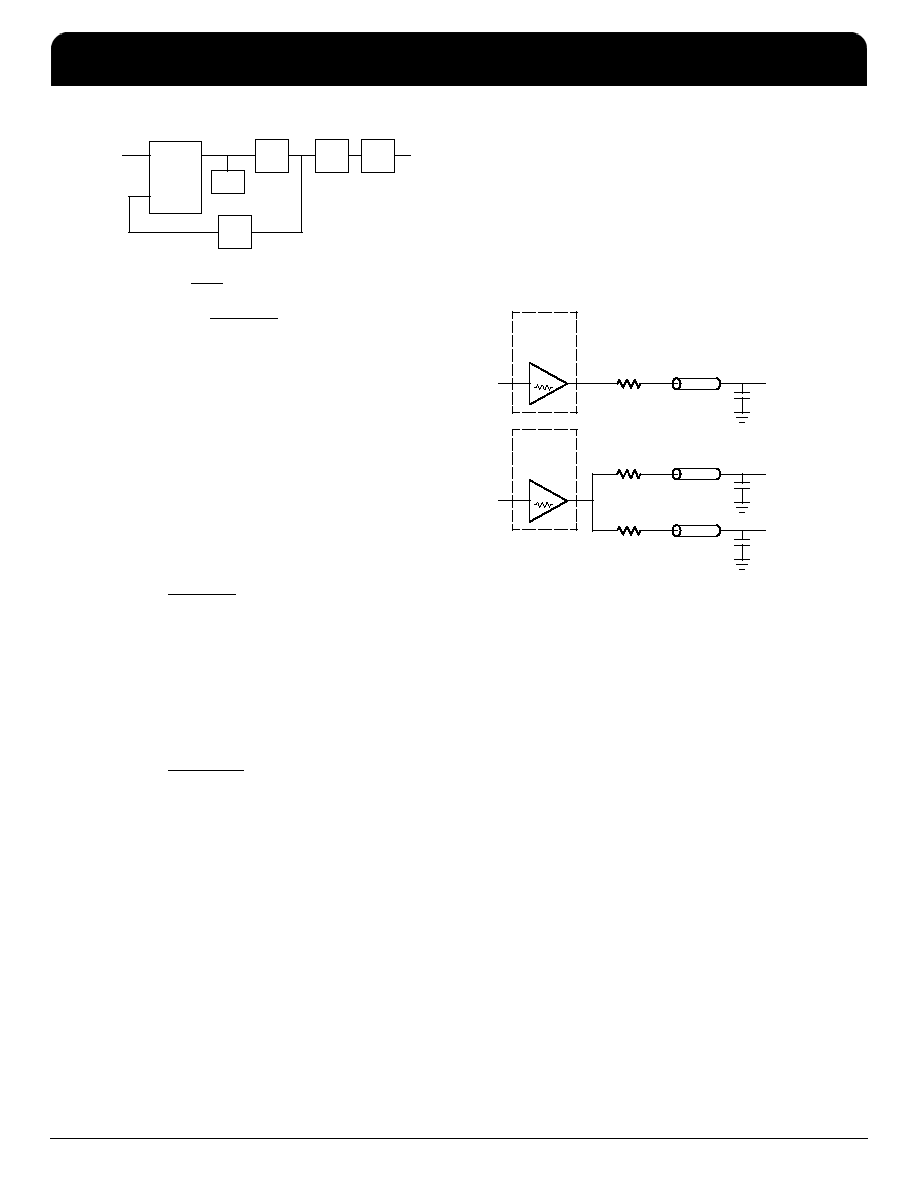
Figure 15. PLL Block Diagram
fref
Phase
Detector
Qn
VCO
LPF
÷P
÷N
÷m
N fref +
fQn N P
m
fref +
fVCO
m
,fVCO + fQnNP
m = 8
P = 1 (Power_Dn=‘0’), 2 (Power_Dn=‘1’)
For the MPC930 clock driver, the following will provide an
example of how to determine the crystal frequency required
for a given design.
Given:
Qa
= 66.6MHz
Qb
= 33.3MHz
Qc
= 22.2MHz
Power_Dn = ‘0’
fref +
fQn N P
m
From Table 4
fQc = VCO/6 then N = 6
From Figure 15
m = 8 and P = 1
fref +
22.22 6 1
8
+ 16.66MHz
Driving Transmission Lines
The MPC930/931 clock driver was designed to drive high
speed signals in a terminated transmission line environment.
To provide the optimum flexibility to the user the output
drivers were designed to exhibit the lowest impedance
possible. With an output impedance of less than 10
the
drivers can drive either parallel or series terminated
transmission lines. For more information on transmission
lines the reader is referred to application note AN1091 in the
Timing Solutions brochure (BR1333/D).
In most high performance clock networks point–to–point
distribution of signals is the method of choice. In a
point–to–point scheme either series terminated or parallel
terminated transmission lines can be used. The parallel
technique terminates the signal at the end of the line with a
50
resistance to VCC/2. This technique draws a fairly high
level of DC current and thus only a single terminated line can
be driven by each output of the MPC930/931 clock driver. For
the series terminated case however there is no DC current
draw, thus the outputs can drive multiple series terminated
lines. Figure 16 illustrates an output driving a single series
terminated line vs two series terminated lines in parallel.
When taken to its extreme the fanout of the MPC930/931
clock driver is effectively doubled due to its capability to drive
multiple lines.
Figure 16. Single versus Dual Transmission Lines
7
IN
MPC930/931
OUTPUT
BUFFER
RS = 43
ZO = 50
OutA
7
IN
MPC930/931
OUTPUT
BUFFER
RS = 43
ZO = 50
OutB0
RS = 43
ZO = 50
OutB1
The waveform plots of Figure 17 show the simulation
results of an output driving a single line vs two lines. In both
cases the drive capability of the MPC930/931 output buffers
is more than sufficient to drive 50
transmission lines on the
incident edge. Note from the delay measurements in the
simulations a delta of only 43ps exists between the two
differently loaded outputs. This suggests that the dual line
driving need not be used exclusively to maintain the tight
output–to–output skew of the MPC930/931. The output
waveform in Figure 17 shows a step in the waveform, this
step is caused by the impedance mismatch seen looking into
the driver. The parallel combination of the 43
series resistor
plus the output impedance does not match the parallel
combination of the line impedances. The voltage wave
launched down the two lines will equal:
VL = VS ( Zo / (Rs + Ro +Zo))
Zo = 50
|| 50
Rs = 43
|| 43
Ro = 7
VL = 3.0 (25 / (21.5 + 7 + 25) = 3.0 (25 / 53.5)
= 1.40V
At the load end the voltage will double, due to the near
unity reflection coefficient, to 2.8V. It will then increment
towards the quiescent 3.0V in steps separated by one round
trip delay (in this case 4.0ns).
F
re
e
sc
a
le
S
e
m
ic
o
n
d
u
c
to
r,
I
Freescale Semiconductor, Inc.
For More Information On This Product,
Go to: www.freescale.com
n
c
..
.
MPC930 MPC931
Low Voltage PLL Clock Driver
NETCOM
IDT Low Voltage PLL Clock Driver
Freescale Timing Solutions Organization has been acquired by Integrated Device Technology, Inc
MPC930 MPC931
11
相关PDF资料 |
PDF描述 |
|---|---|
| MPC930FA | 140 MHz, PROC SPECIFIC CLOCK GENERATOR, PQFP32 |
| MPC972FA | 125 MHz, PROC SPECIFIC CLOCK GENERATOR, PQFP52 |
| MPC9850VF | 500 MHz, PROC SPECIFIC CLOCK GENERATOR, PBGA100 |
| MPC9850VMR2 | 500 MHz, PROC SPECIFIC CLOCK GENERATOR, PBGA100 |
| MPC9850VMR2 | 500 MHz, PROC SPECIFIC CLOCK GENERATOR, PBGA100 |
相关代理商/技术参数 |
参数描述 |
|---|---|
| MPC931 | 制造商:Motorola Inc 功能描述: |
| MPC9315 | 制造商:MOTOROLA 制造商全称:Motorola, Inc 功能描述:2.5V and 3.3V CMOS PLL Clock Generator and Driver |
| MPC9315AC | 功能描述:锁相环 - PLL 2.5 3.3V 160MHz Clock Generator RoHS:否 制造商:Silicon Labs 类型:PLL Clock Multiplier 电路数量:1 最大输入频率:710 MHz 最小输入频率:0.002 MHz 输出频率范围:0.002 MHz to 808 MHz 电源电压-最大:3.63 V 电源电压-最小:1.71 V 最大工作温度:+ 85 C 最小工作温度:- 40 C 封装 / 箱体:QFN-36 封装:Tray |
| MPC9315ACR2 | 功能描述:时钟发生器及支持产品 FSL 1-8 LVCMOS PLL Clock Generator RoHS:否 制造商:Silicon Labs 类型:Clock Generators 最大输入频率:14.318 MHz 最大输出频率:166 MHz 输出端数量:16 占空比 - 最大:55 % 工作电源电压:3.3 V 工作电源电流:1 mA 最大工作温度:+ 85 C 安装风格:SMD/SMT 封装 / 箱体:QFN-56 |
| MPC9315FA | 功能描述:锁相环 - PLL 2.5 3.3V 160MHz Clock Generator RoHS:否 制造商:Silicon Labs 类型:PLL Clock Multiplier 电路数量:1 最大输入频率:710 MHz 最小输入频率:0.002 MHz 输出频率范围:0.002 MHz to 808 MHz 电源电压-最大:3.63 V 电源电压-最小:1.71 V 最大工作温度:+ 85 C 最小工作温度:- 40 C 封装 / 箱体:QFN-36 封装:Tray |
发布紧急采购,3分钟左右您将得到回复。