- 您现在的位置:买卖IC网 > PDF目录17066 > DC746A (Linear Technology)BOARD DELTA SIGMA ADC LTC2412 PDF资料下载
参数资料
| 型号: | DC746A |
| 厂商: | Linear Technology |
| 文件页数: | 17/36页 |
| 文件大小: | 0K |
| 描述: | BOARD DELTA SIGMA ADC LTC2412 |
| 软件下载: | QuikEval System |
| 设计资源: | DC746A Design File DC746A Schematic |
| 标准包装: | 1 |
| 系列: | QuikEval™ |
| ADC 的数量: | 1 |
| 位数: | 24 |
| 采样率(每秒): | 7.5 |
| 数据接口: | MICROWIRE?,串行,SPI? |
| 工作温度: | 0°C ~ 70°C |
| 已用 IC / 零件: | LTC2412 |
| 已供物品: | 板 |
| 相关产品: | DC590B-ND - BOARD DEMO USB SERIAL CONTROLLER LTC2412IGN#PBF-ND - IC ADC 2CH DIFF-IN 24BIT 16SSOP LTC2412IGN#TRPBF-ND - IC ADC 2CH DIFF-IN 24BIT 16SSOP LTC2412CGN#TRPBF-ND - IC ADC 2CH DIFF-IN 24BIT 16SSOP LTC2412CGN#PBF-ND - IC ADC 2CH DIFF-IN 24BIT 16SSOP LTC2412IGN#TR-ND - IC CONV A/D 24B 2CH DIFF 16-SSOP LTC2412CGN#TR-ND - IC CONV A/D 24B 2CH DIFF 16-SSOP LTC2412IGN-ND - IC CONV A/D 24B 2CH DIFF 16-SSOP LTC2412CGN-ND - IC ADC 2CH DIFF-IN 24BIT 16SSOP |
第1页第2页第3页第4页第5页第6页第7页第8页第9页第10页第11页第12页第13页第14页第15页第16页当前第17页第18页第19页第20页第21页第22页第23页第24页第25页第26页第27页第28页第29页第30页第31页第32页第33页第34页第35页第36页
LTC2412
24
2412f
APPLICATIO S I FOR ATIO
WU
U
For a simple approximation, the source impedance RS
driving an analog input pin (IN+, IN–, REF+ or REF–) can be
considered to form, together with RSW and CEQ (see
Figure 11), a first order passive network with a time
constant
τ = (RS + RSW) CEQ. The converter is able to
sample the input signal with better than 1ppm accuracy if
the sampling period is at least 14 times greater than the
input circuit time constant
τ. The sampling process on the
four input analog pins is quasi-independent so each time
constant should be considered by itself and, under worst-
case circumstances, the errors may add.
When using the internal oscillator (FO = LOW or HIGH), the
LTC2412’s front-end switched-capacitor network is clocked
at 76800Hz corresponding to a 13
s sampling period.
Thus, for settling errors of less than 1ppm, the driving
source impedance should be chosen such that
τ≤13s/14
= 920ns. When an external oscillator of frequency fEOSC is
used, the sampling period is 2/fEOSC and, for a settling
error of less than 1ppm,
τ ≤ 0.14/fEOSC.
Input Current
If complete settling occurs on the input, conversion re-
sults will be unaffected by the dynamic input current. An
incomplete settling of the input signal sampling process
may result in gain and offset errors, but it will not degrade
the INL performance of the converter. Figure 11 shows the
mathematical expressions for the average bias currents
flowing through the IN+ and IN– pins as a result of the
sampling charge transfers when integrated over a sub-
stantial time period (longer than 64 internal clock cycles).
The effect of this input dynamic current can be analyzed
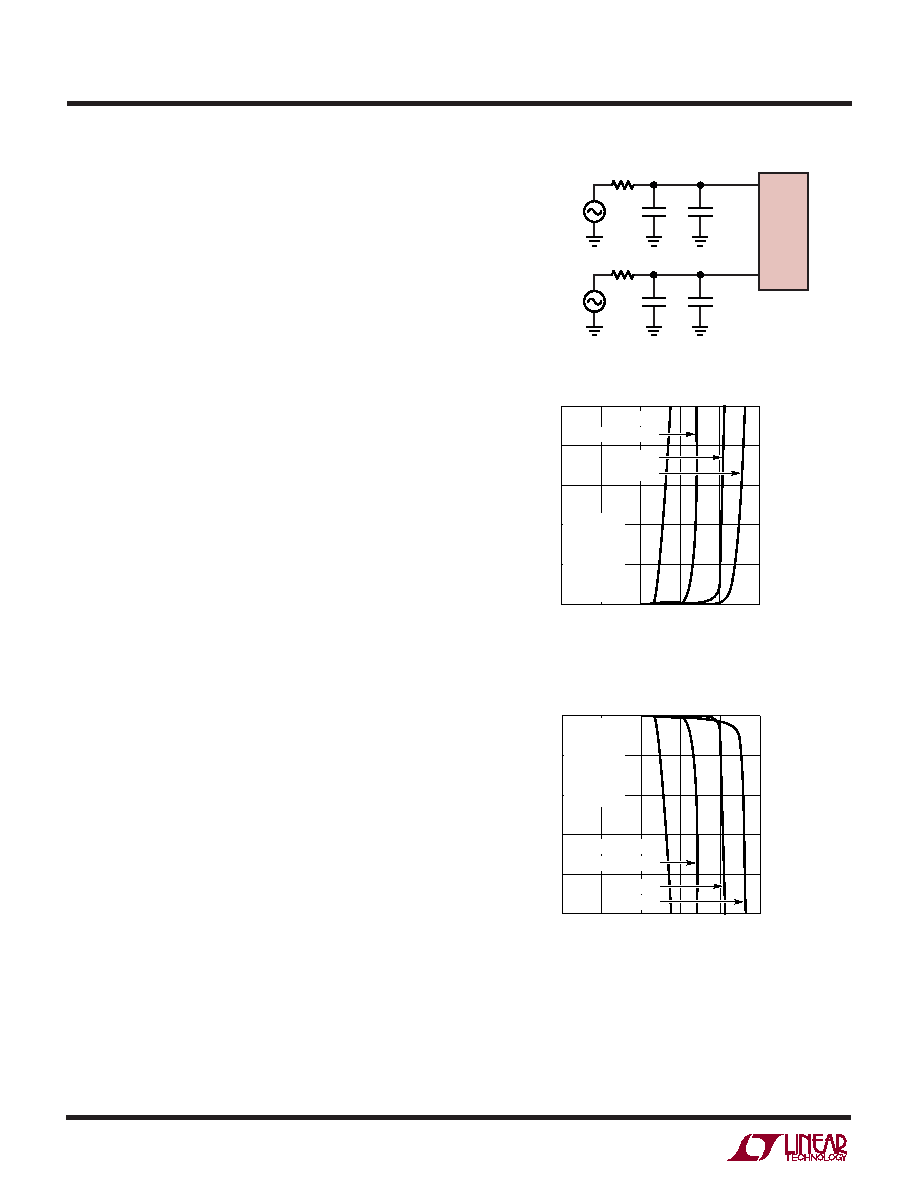
using the test circuit of Figure 12. The CPAR capacitor
includes the LTC2412 pin capacitance (5pF typical) plus
the capacitance of the test fixture used to obtain the results
shown in Figures 13 and 14. A careful implementation can
bring the total input capacitance (CIN + CPAR) closer to 5pF
thus achieving better performance than the one predicted
by Figures 13 and 14. For simplicity, two distinct situa-
tions can be considered.
For relatively small values of input capacitance (CIN <
0.01
F), the voltage on the sampling capacitor settles
almost completely and relatively large values for the
source impedance result in only small errors. Such values
CIN
2412 F12
VINCM + 0.5VIN
RSOURCE
IN+
LTC2412
CPAR
20pF
CIN
VINCM – 0.5VIN
RSOURCE
IN –
CPAR
20pF
Figure 12. An RC Network at IN+ and IN–
Figure 14. –FS Error vs RSOURCE at IN+ or IN– (Small CIN)
Figure 13. +FS Error vs RSOURCE at IN+ or IN– (Small CIN)
RSOURCE ()
1
10
100
1k
10k
100k
+FS
ERROR
(ppm
OF
V
REF
)
2412 F13
50
40
30
20
10
0
VCC = 5V
REF+ = 5V
REF – = GND
IN+ = 5V
IN– = 2.5V
FO = GND
TA = 25°C
CIN = 0.01F
CIN = 0.001F
CIN = 100pF
CIN = 0pF
RSOURCE ()
1
10
100
1k
10k
100k
–
FS
ERROR
(ppm
OF
V
REF
)
2412 F14
0
–10
–20
–30
–40
–50
VCC = 5V
REF+ = 5V
REF – = GND
IN+ = GND
IN– = 2.5V
FO = GND
TA = 25°C
CIN = 0.01F
CIN = 0.001F
CIN = 100pF
CIN = 0pF
for CIN will deteriorate the converter offset and gain
performance without significant benefits of signal filtering
and the user is advised to avoid them. Nevertheless, when
small values of CIN are unavoidably present as parasitics
相关PDF资料 |
PDF描述 |
|---|---|
| SLPX222M100C7P3 | CAP ALUM 2200UF 100V 20% SNAP |
| RS3-243.3DZ/H3 | CONV DC/DC 3W 9-27VIN +/-3.3VOUT |
| AP2162MPG-13 | IC PWR SW USB 2CH 1A 8-MSOP |
| RS3-2415DZ/H3 | CONV DC/DC 3W 9-27VIN +/-15VOUT |
| SC75B-470 | INDUCTOR SMD 47UH 1.10A 2.52MHZ |
相关代理商/技术参数 |
参数描述 |
|---|---|
| DC74HC259 | 制造商:TI 制造商全称:Texas Instruments 功能描述:High Speed CMOS Logic 8-Bit Addressable Latch |
| DC-750 | 制造商:Bivar 功能描述:CARD GUIDE DEEP 7.5" 0.08" BK |
| DC-750-102 | 制造商:Bivar 功能描述:CARD GUIDE DEEP 7.5" 0.102" BK |
| DC-750-102-CI | 制造商:Bivar 功能描述:CARD GUIDE INSERT 7.5" 0.102" BK |
| DC750KA | 制造商:Dewalt 功能描述:9.6V 3/8" Cordless Compact Drill/Driver Kit 制造商:DEWALT 功能描述:9.6V DRILL/DRIVER KIT 3/8 RATCHETING CHUCK |
发布紧急采购,3分钟左右您将得到回复。